 codesignprojects
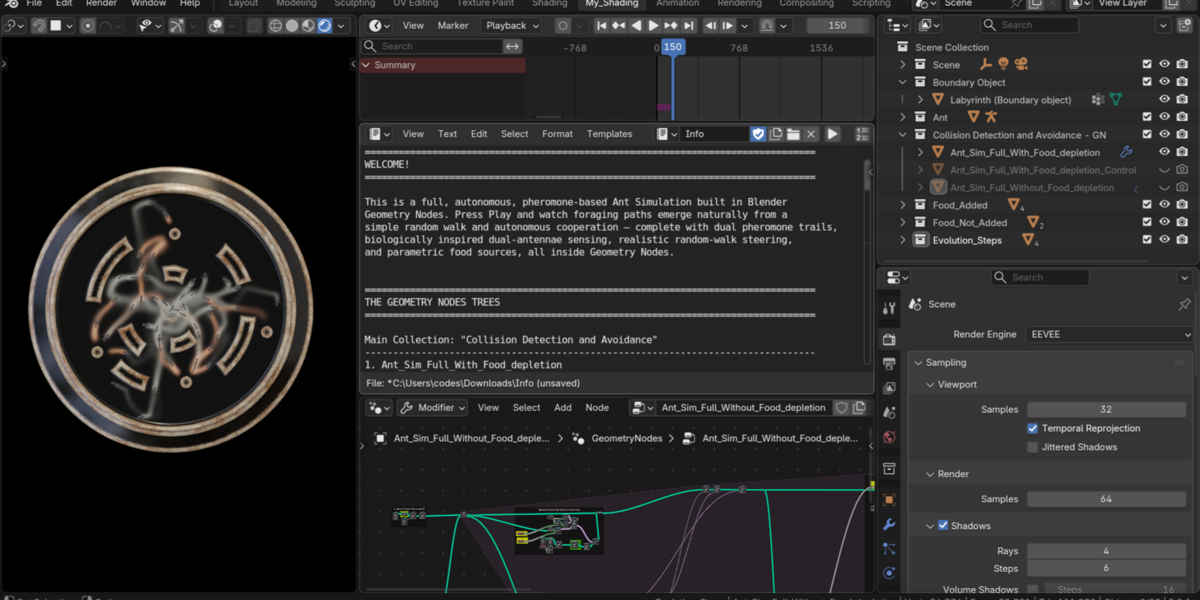
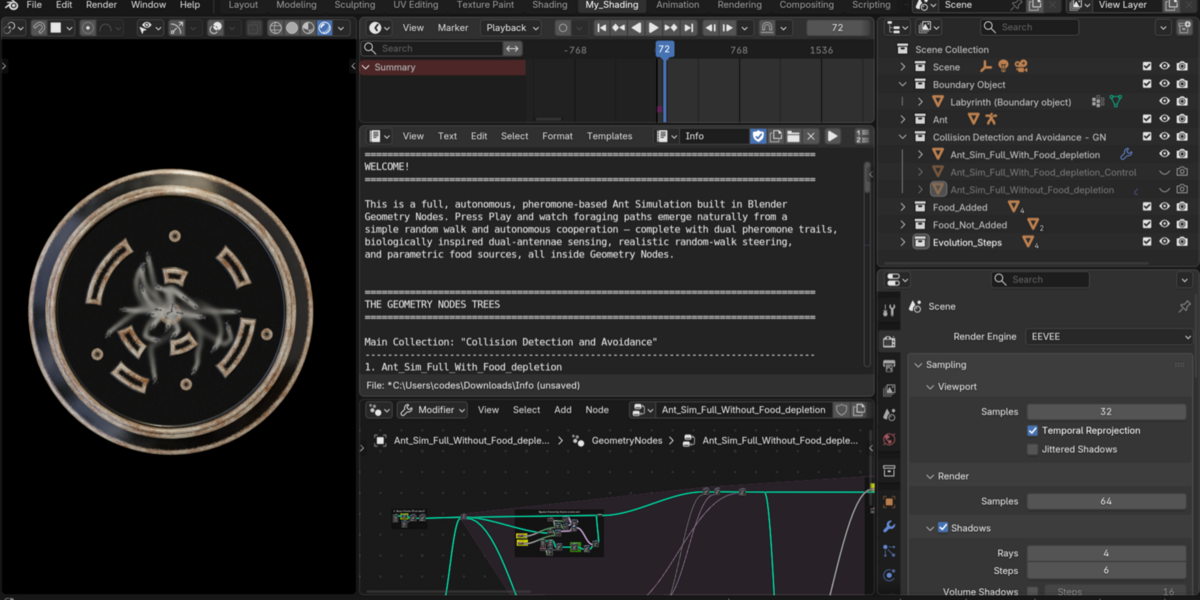
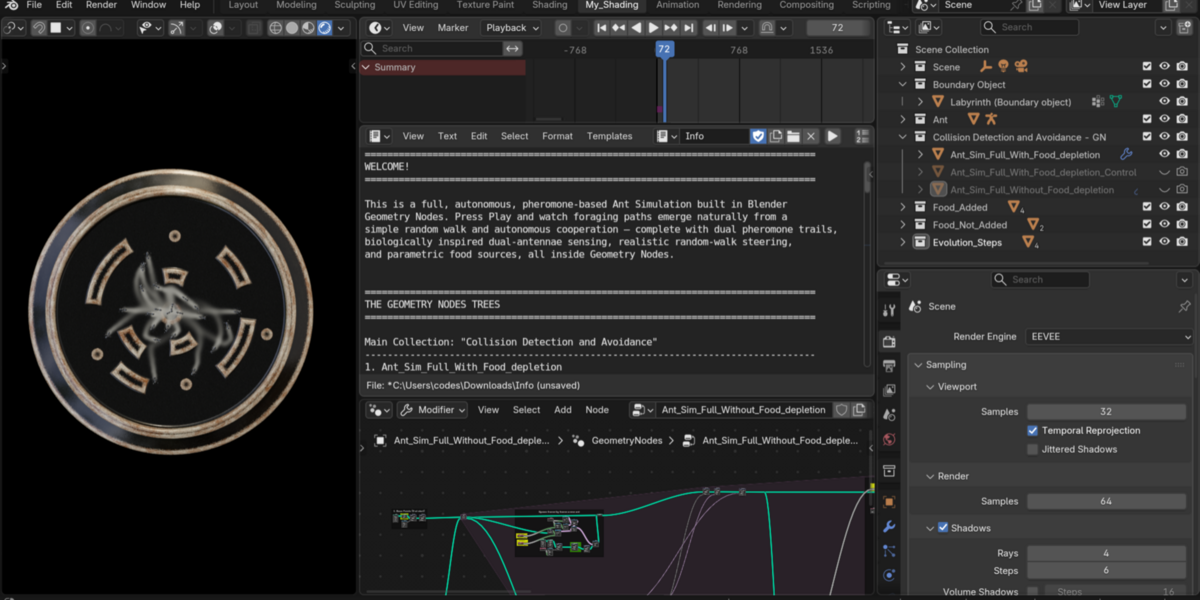
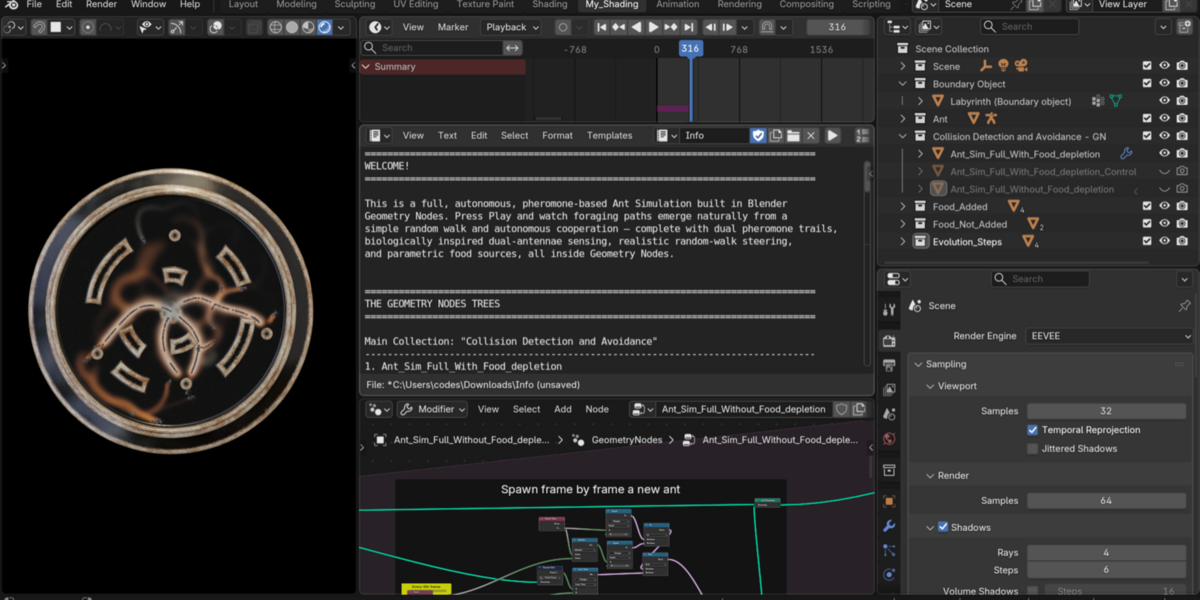
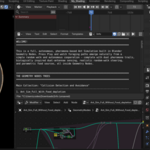
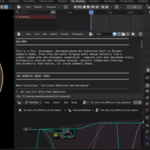
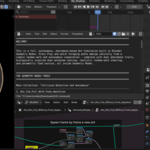
A pure Geometry Nodes implementation of an autonomous, pheromone-based Ant Colony Simulation. Complete with dual pheromone trails, biologically inspired dual-antennae sensing, realistic random-walk steering, wall collision avoidance, and parametric, depleting food sources - all built from the ground up inside Geometry Nodes. True Stigmergy and emergent paths, order form chaos.
▶ Video Demos: Demo (YouTube)
The Logic:
-
3-State Random Walk: At randomized individual frame intervals, each ant chooses to turn left, turn right, or walk straight ahead.
-
Boundary Rebound: Whenever an ant encounters an obstacle or boundary wall, it detects the collision and steers away.
-
Dual Pheromones (Blue & Red): Ants leave a Blue trail while searching away from the nest, and switch to laying a Red trail as soon as they find food.
-
Dual-Antennae Sensing: Each ant checks for pheromones using two virtual antennae angled to its front-left and front-right.
-
Trail Following: Searching ants (no food) follow Red pheromone trails with a bit of added wiggle, while returning ants (carrying food) follow Blue trails home.
- Short-Range Homing: Ants also have a short-range scent radius for both the nest and food—the closer they get, the more strongly they pull toward it.
What is Included:
Everything is placed cleanly inside a single organized .blend file with full in-file Text Editor notes. For exact details, see the Documentation or FAQ section.
Main Simulation Setups (Collection: Collision Detection and Avoidance):
- 1.
Ant_Sim_Full_With_Food_depletion(Main Educational Tree): Contains all simulation elements—random walk, boundary raycasting, dual Blue/Red pheromone grids, dual-antennae sensing, potency decay, nest recycling, and depleting food HP. All customizable parameters sit inside bright Yellow frames directly inside their corresponding node sections so you can inspect and experiment as you explore the tree. - 2.
Ant_Sim_Full_With_Food_depletion_Control(Modifier-Controlled Version): Identical simulation logic to (1), but with all 24 customizable parameters exposed directly in the Modifier Properties tab, organized into 6 clean categories (Swarm & Spawning, Random Wander, Pheromone Grid, Pheromone Dynamics, Scent Halos & Sensing, and Food & Depletion). Ideal for live tweaking and observing emergent behavior. Additional Control HUD added to see live stats! - 3.
Ant_Sim_Full_Without_Food_depletion(Streamlined Tree): The complete dual-pheromone foraging simulation without the extra food-depletion tracking logic, making the core pheromone and steering graph even cleaner and easier to read.
4 Progressive Learning Examples (Collection: Evolution_Steps):
-
Step_1_Autonomous_Swarm_With_Random_Movement: Establishes time-gated point emission, population capping, and stepped random-walk steering. -
Step_2_Add_Boundary_Detection_And_Collision_Avoidance: Adds forward raycasting against boundary/labyrinth geometry for bidirectional wall rebound. -
Step_3_Leave_Pheromone_Trail_And_Visualize: Introduces the separate procedural 2D pheromone grid, proximity-based scent deposition, diffusion blur, and frame-by-frame evaporation. -
Step_4_Follow_Pheromone_Trail: Connects dual-antennae left/right grid sampling, trail steering, wander dampening, and food/nest attraction loops.
Workflow Tip:
New to Simulation ? Start by unhiding and playing through Step 1 → Step 4 in the Evolution_Steps collection, then jump into Ant_Sim_Full_With_Food_depletion_Control to tweak the colony live from the Modifier tab!
There is a setup, sort of precursor to this product, the The Hive - Procedural Boundary and Self-Collision Avoidance in Geometry Nodes. That setup is building an autonomous swarm with random walk, and adds not only boundary, but self-collision awareness and avoidance !
Developer's Note:
These node trees are kept open and modular for readability and feature detailed frame-by-frame explanations. Everything is built from pure math and standard Geometry Nodes from the ground up.
The goal is to provide a transparent core of the mathematical and biological concept, node by node, rather than hiding equations inside locked node groups. You can inspect, modify, and extend every branch to realize your own simulations and visualizations.
This implementation was inspired by programmatic Ant Simulation examples, like Sebastian Lague's.
Support & Contact:
Superhive Inbox
[email protected]
See more on Instagram or YouTube
Recommended Tools:
The Wire
Kinetica
The Visitor