 Nicu_Anna_Tepes_Vulpe


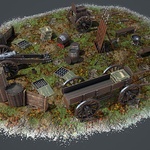
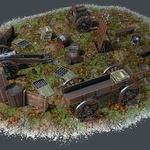
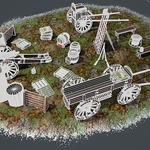
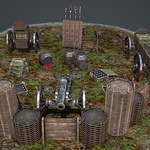
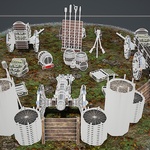
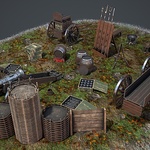
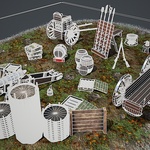
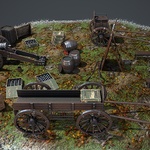
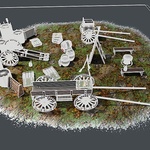
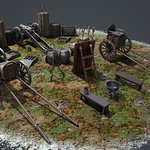
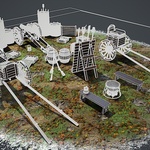
Cannon Unicorn with accessories
A fine autumn day in 1812. A formidable weapon—a heavy cast-iron cannon on a massive carriage—stands motionless in an open position, protected by a low hill. Its muzzle, polished to a dark sheen, seems dormant, staring at the clear sky, but the entire surroundings suggest the approach of instant combat.
Right within the steel wheels, a pyramid of companions is stacked—soldiers' muskets with fixed bayonets. Nearby, in sturdy wooden boxes, cast-iron cannonballs—cold, heavy spheres of death—are neatly laid out. Loading supplies—a swab, a ramrod, and loading cards—are left on a plain bench. Barrels of gunpowder stand just a little further away, evoking a superstitious trepidation.
The surrounding area is protected from enemy fire by gabions—symbols and small wicker baskets filled with earth. Behind them stand crude wooden parapets. Two carts provide supplies: a four-wheeled one with supply crates and a light two-wheeled cart, ready at any moment to deliver ammunition boxes directly to the gun.
But even on the threshold of the installation, life takes its toll. A campfire smolders, over which a cast-iron cauldron of steaming porridge, with a wooden spoon stuck in it, lingers. Wooden buckets of water stand nearby. These simple utensils recall the soldier's life, which requires constant lulls between hunts, as is customary. An uneasy silence hangs in the air, foreshadowing the coming battle. Everything is ready, and now the first shot is fired.
polys 365084
verts 367399
tris 730168
materials 42
textures 210