 Quadrivium369



MouldCast Studio
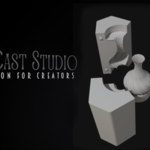
MouldCast Studio is a procedural mold generation tool for Blender designed for makers working with casting workflows.
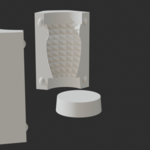
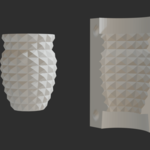
The system converts a 3D object into a complete mold structure ready for fabrication. Instead of manually modeling mold halves, planning seams, and building block geometry, the tool generates the mold automatically while keeping everything fully adjustable.
Load an object, define the mold parameters, and generate a clean mold system in seconds.
The resulting mold parts can be exported directly as STL files for 3D printing and used to produce molds for materials such as ceramics, plaster, resin, wax, or silicone.
Why this tool exists
Designing molds manually in traditional modeling workflows can be slow and repetitive. Each new object requires rebuilding the same mold structure again and again.
MouldCast Studio turns mold creation into a procedural step. Once the model is prepared, the mold can be generated instantly and adjusted through simple controls.
This makes it especially useful when producing prototypes, variations, or small production series.
Main features
• Generate molds directly from any 3D object
• Adjustable number of mold parts
• Procedural mold block generation
• Alignment keys for accurate mold assembly
• Optional pouring hole system
• Base structure controls
• Visual separation preview for inspection
• Export mold parts as STL files for 3D printing
Typical applications
MouldCast Studio is useful for a wide range of fabrication workflows:
• ceramic slip casting
• candle molds
• resin casting
• plaster molds
• silicone master molds
• craft production
• small product manufacturing
Workflow
-
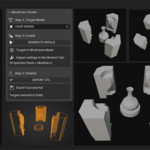
Select the object you want to cast
-
Generate the mold system
-
Adjust mold parameters if needed
-
Inspect the mold using the separation view
-
Export the mold parts as STL files
-
Print and produce the mold
Requirements
Blender 4.5 or greater.
Basic familiarity with Blender is recommended.
Philosophy
MouldCast Studio was created to simplify mold design by removing repetitive modeling work. The goal is to allow makers to focus on designing the object itself, while the mold structure is generated automatically.