Pythian Dragon Animators Pack
 Jana-Marleen Nolte


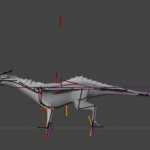
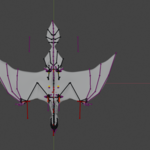
Explanation of the Armature
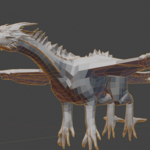
Red, Orange, Yellow: These bones are the main controls of the armature. For creating a pose, they are the ones to use. The orange bones are only for the front legs, while the yellow ones are for the hind legs. These are the only bones, that have English names. The others are primarily in German.
Violet: These bones are controlled by the red, orange and yellow bones, but can be also controlled by the user. That can be used to arrange details in a pose.
Black: These bones are primarily controlled by the red, orange and yellow ones. The black bones are used for: Ik, Spline IK, Correct Parenting with automatic weights
Main bones
1) Origin: This Bone moves the entire armature.
2) Main body: This bone moves the body of the dragon while the feet and head stay unmoved.
3) Spine: The left bone controls the position of the breast, while the right one controls the hip. The middle bone defines the curvature of the spine.
4) Tail: This bone drives the movement of the tail. A natural swing of the tail is achieved by damped track constraints. The tail collides with the floor (bone 16).
5) Neck: The left bone controls the position and rotation of the head, while the other two bones follow this movement. To achieve the expected curvature of the neck, you need to use the middle bone.
6) Mouth: This bone opens and closes the mouth.
7) Eye: This bone controls the direction of view.
8) Breathing: This bone drives deformations in the ribcage, the stomach and the shoulders to let the dragon breath.
9) Upper leg-Pole Bones: These bones are used to define the exact Position of knee, elbow and shoulder. They are mostly defined by the movement of the IK-Bone of each leg.
10) Hand and Foot Pivot: These bones can rotate the wrist and the ankle without a change in the position and rotation of the fingers or toes.
11) Finger and Toe: These Bones rotate the fingers and toes without moving the entire foot or hand.
12) Hand/foot/Shoulder IK: These Bones control the position and rotation of the entire foot or hand.
13) Wing-Pivot: These bones rotates the “hand” of the wing, without moving its “fingers”.
14) Wing IK: These bones move the entire wing.
15) Wing-Pole: These bones define the position of the elbow of the wings.
Have questions about this product?
Login to message
| Dev Fund Contributor | |
| Published | 10 months ago |
| Blender Version | 3.6 - 4.5 |
| Render Engine Used | Cycles, Eevee |
| Misc Data | Uvs-Unwrapped, Manifold-Mesh, Rigged, Animated, Low-High-Resolution, Normal-Mapped, Textured |
| License | Royalty Free |
