 marzoni
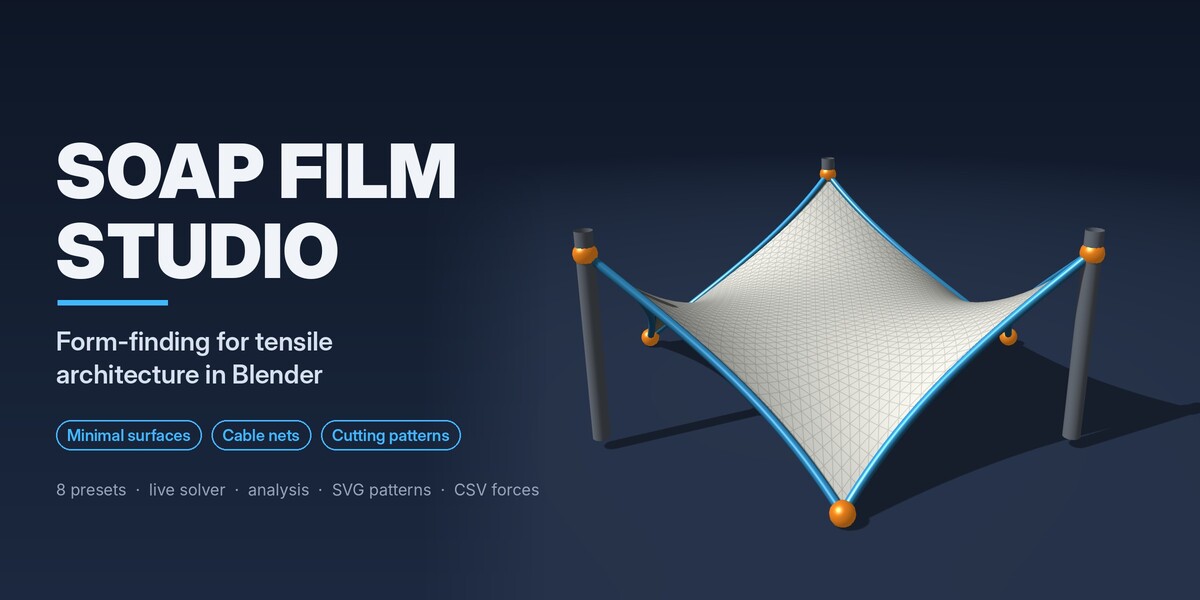
Form-finding for tensile architecture in Blender: minimal surfaces (soap films), cable nets, pneumatic cushions and hanging models for compression shells, plus analysis, true-size cutting patterns, engineering forces and render-ready rigs.
Version 1.0.0 · Blender 4.2 LTS to 5.x · GPL-3.0-or-later
1. Installation
Blender 4.2 and newer (recommended)
- Download
soap_film_studio_v1.0.0.zip. Do not unzip it. - In Blender: Edit › Preferences › Get Extensions, open the drop-down arrow at the top right and pick Install from Disk…
- Select the zip. The add-on is enabled automatically.
- You can also drag and drop the zip onto the Blender window.
The tools appear in the 3D Viewport sidebar (press N), tab Soap Film, and in Add › Mesh › Soap Film Studio.
No internet connection and no extra Python packages are needed (NumPy ships with Blender).
Update: install the new zip the same way. Remove: Preferences › Add-ons, find Soap Film Studio, click the arrow and choose Uninstall.
2. Quick start (60 seconds)
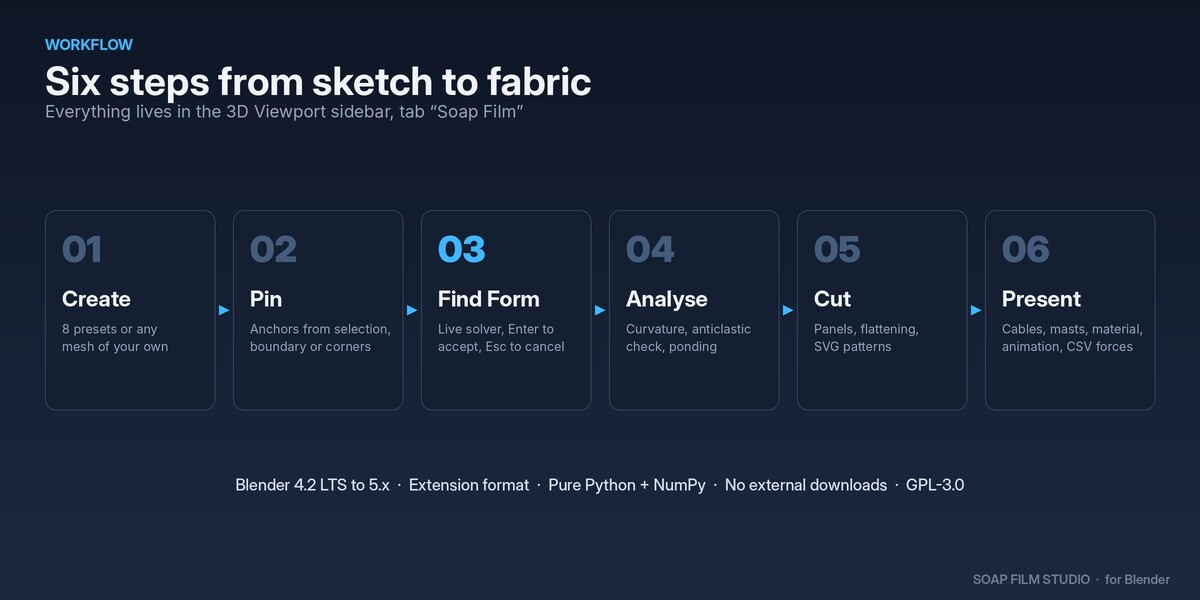
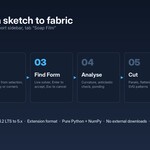
- Sidebar › Soap Film › click Hypar Sail. A membrane appears, already form-found.
- Press Tab, move one of the orange anchor points up, press Tab again.
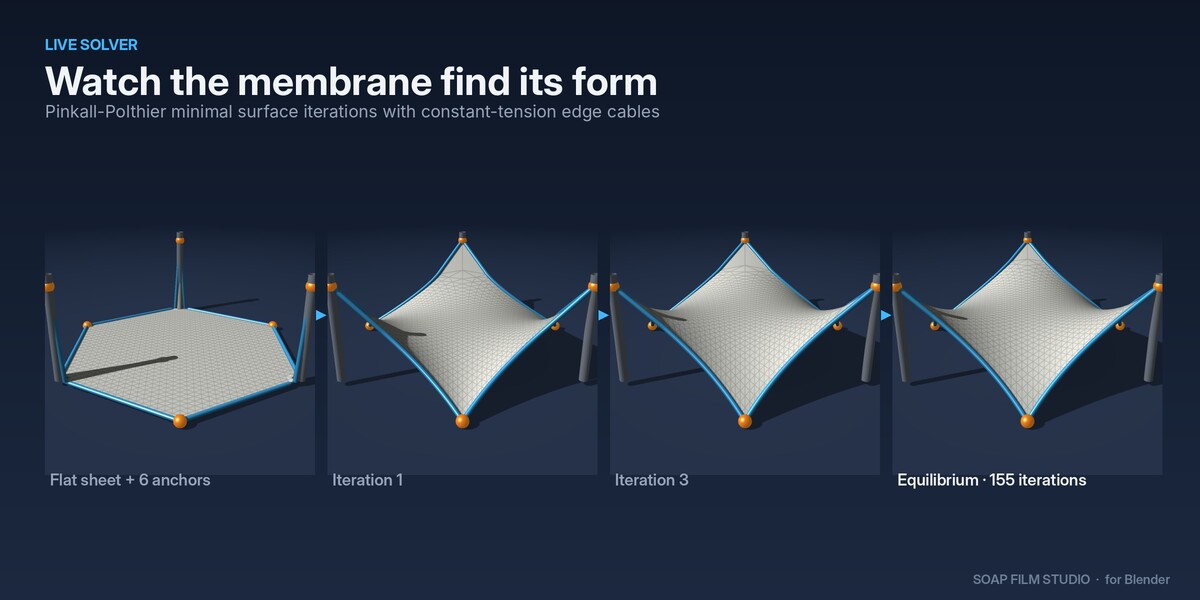
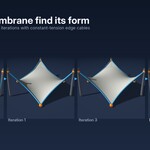
- Click Find Form. Watch the membrane settle. Press Enter to accept or Esc to cancel.
- Open Analysis, choose Anticlastic Check, click Analyse.
- Open Presentation, click Build Render Rig, then render.
3. Concepts
| Term | Meaning |
|---|---|
| Anchor | A fixed support vertex (mast head, ground plate, frame). Stored in the vertex group SFS_Anchors. Shown as orange points. |
| Edge cable | Every free boundary edge between anchors. Cables carry constant tension and form arcs (blue lines). |
| Soap Film method | Minimal surface: uniform surface tension in every direction. Exact for fabric with equal warp and fill pre-stress. |
| Cable Net method | Force density method on the mesh edges. Use it for tall conic tents, quad cable nets and hanging models. |
| Start shape | Stored automatically before the first solve, so Reset Shape always brings you back. |
4. Panels
Soap Film Studio (presets)
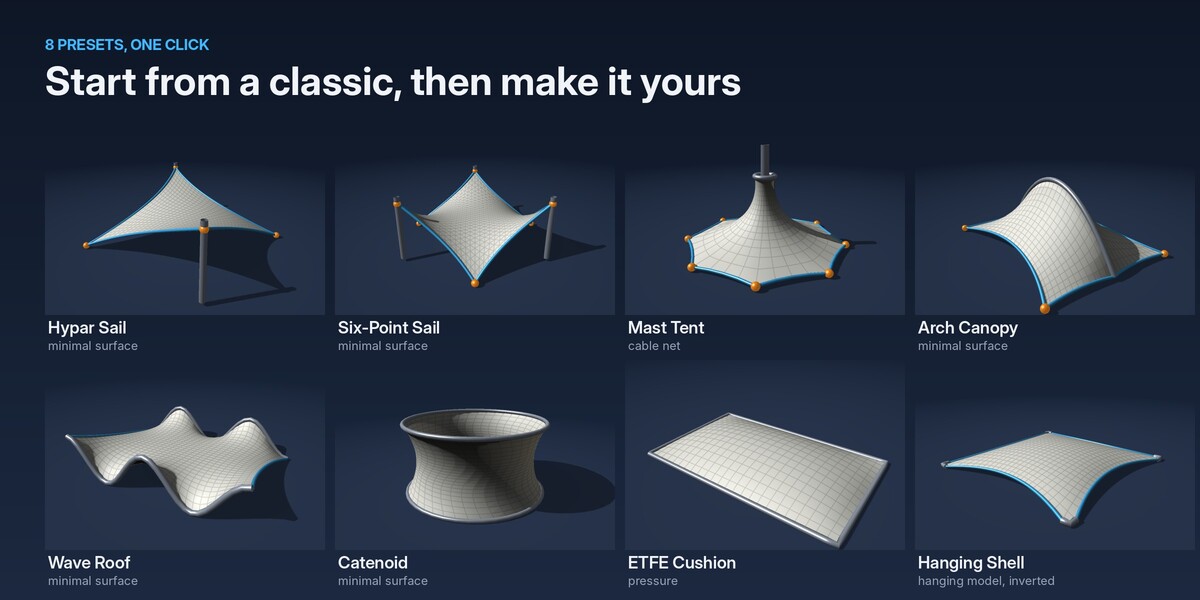
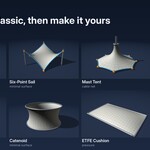
Eight presets, each ready to solve with anchors, cables and settings:
| Preset | Method | Notes |
|---|---|---|
| Hypar Sail | Soap film | 4 corners, 2 high, 2 low |
| Six-Point Sail | Soap film | alternating high and low corners |
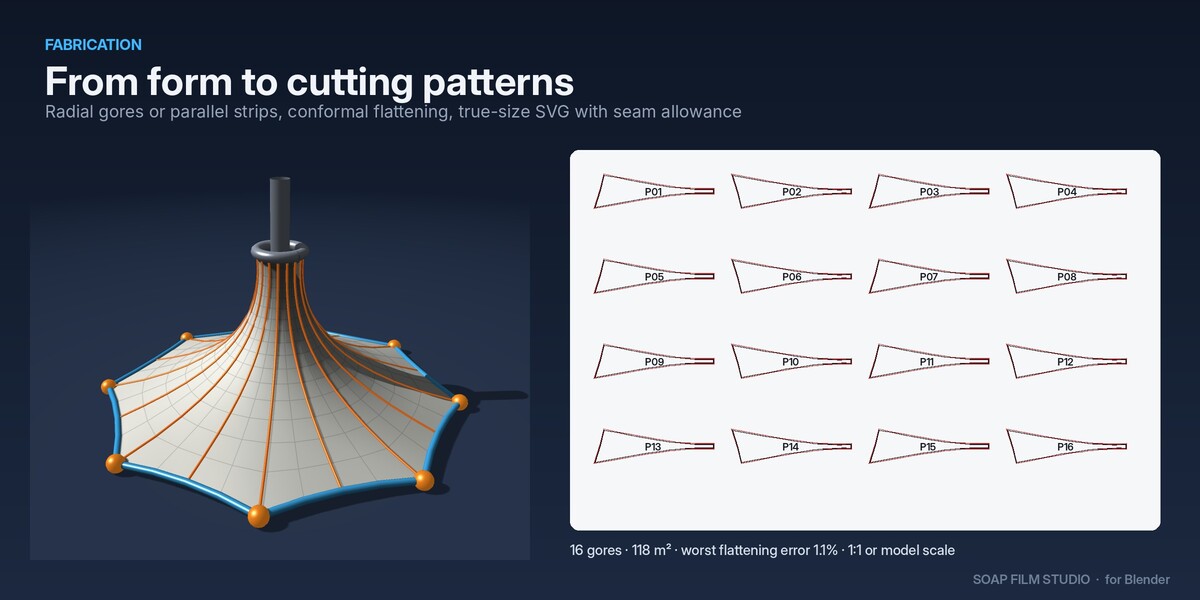
| Mast Tent | Cable net | mast-head ring, 8 ground anchors, radial gores |
| Arch Canopy | Soap film | parabolic arch along the ridge |
| Wave Roof | Soap film | two undulating edge beams in opposite phase |
| Catenoid | Soap film | the classic film between two rings |
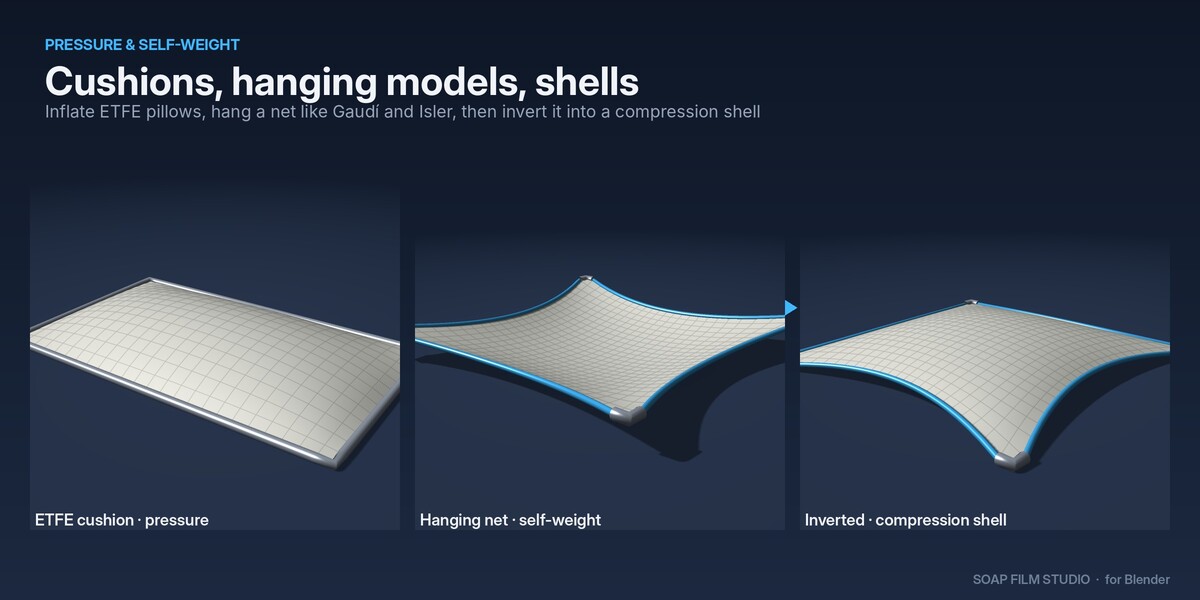
| ETFE Cushion | Soap film + pressure | rigid frame, inflated pillow |
| Hanging Shell | Cable net + self-weight | hang it, then Invert |
The Add Membrane redo panel (bottom left of the viewport) lets you change size, height and mesh resolution after adding.
Show Anchors & Cables toggles the viewport overlay.
Anchors
Works on any mesh with faces, not only the presets.
- Assign / Remove: in Edit Mode, select vertices, then click.
- Select: selects all anchors (enters Edit Mode).
- Pin Boundary: fixes the whole outline (a wire frame for a soap film).
- Pin Corners: fixes the sharp corners of the outline.
- Clear: releases all anchors.
Tip: when you subdivide the mesh, new vertices between two anchors become anchors too, so rigid frames stay rigid.
Form-Finding
| Setting | Effect |
|---|---|
| Method | Soap Film (minimal surface) or Cable Net (force density) |
| Edge Cables + Cable Tension | Cable tension relative to the film. Free edges form arcs of radius ≈ tension × span. Higher values give straighter edges. |
| Pressure | Inflates (positive) or sucks in (negative) the membrane. For cushions and air halls. |
| Self-Weight | Load per unit area along world −Z. Use it for hanging models. |
| Mesh Relax | Slides vertices within the surface to keep triangles even. It does not change the shape. |
| Step Size | Lower it (0.3 to 0.6) if strong pressure or loads make the solve jump around. |
| Max Iterations | Upper limit. The solver stops by itself once the shape has settled. |
Find Form runs live. Enter or Space accepts, Esc or right-click cancels. You can orbit the view while it runs. Called from a script, it runs straight to the result.
The status box shows the iterations, the residual (out-of-balance force), the membrane area and the cable length.
"Film pinched": no minimal surface exists for these anchors. A real soap film would pop, for example with a very tall, narrow cone. Lower the high points, enlarge the mast ring, add anchors or switch to Cable Net.
Analysis
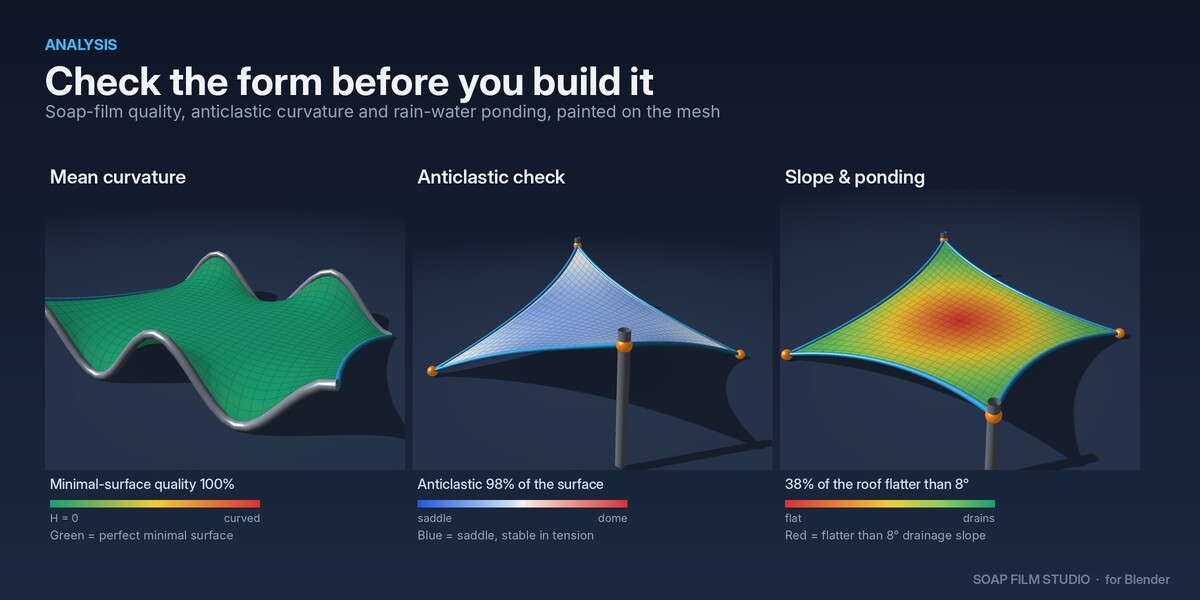
Results are painted on the mesh (Solid view, colour = Attribute, set automatically):
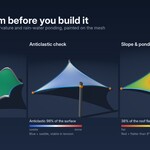
- Mean Curvature: green means a true minimal surface. With pressure, a uniform colour is expected (constant mean curvature).
- Anticlastic Check: blue = saddle-shaped (stable in tension), red = dome-shaped (needs pressure, or it wrinkles).
- Slope & Ponding: red = flatter than the drainage slope you set, magenta = water pockets (local low points).
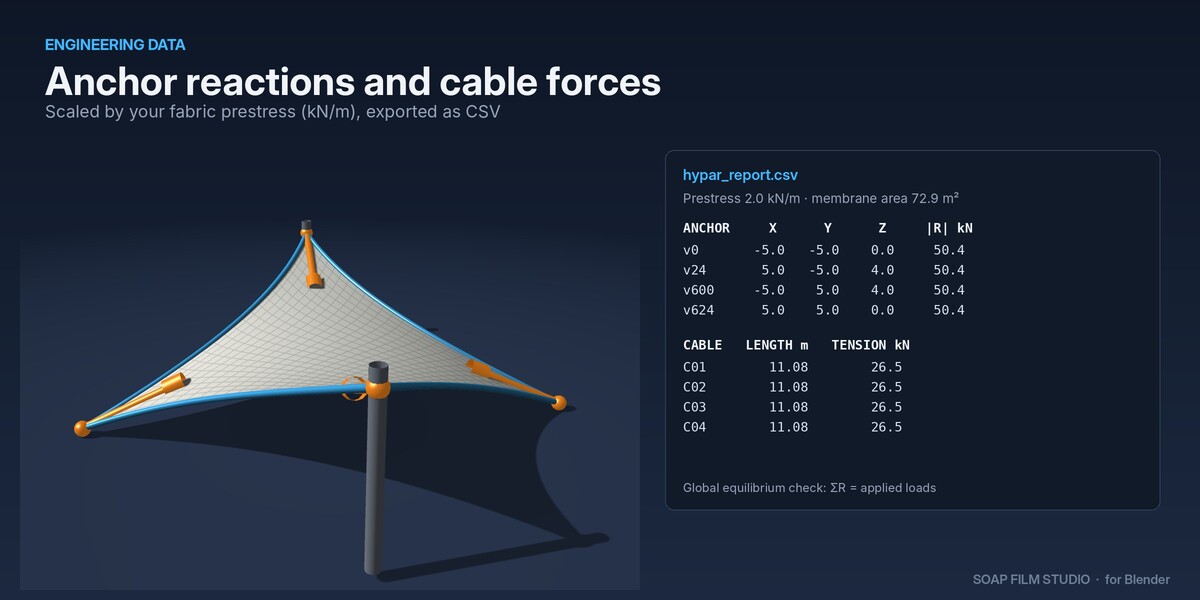
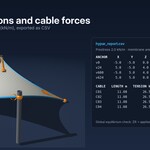
Prestress (kN/m) and Export Report (CSV) write anchor coordinates, support reactions (Rx, Ry, Rz, |R| in kN), cable lengths and tensions, the membrane area and an equilibrium check. The forces scale linearly with the prestress (typical PVC/PES fabric: 1 to 3 kN/m).
The report comes from form-finding only. It is not a structural analysis. Have the final design checked by a qualified engineer.
Cutting Patterns
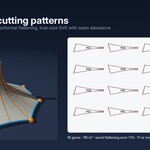
- Choose Along X, Along Y or Radial (gores around the centre) and the number of panels.
- Generate Panels duplicates the membrane, cuts it with planes and marks the seams. The original membrane is hidden, not changed.
- Set the Seam Allowance (mm) and the Model Scale 1: (1 = full size, 50 = a 1:50 physical model).
- Export Cutting Patterns (SVG): every panel is flattened with a conformal (angle-preserving) unwrap, scaled to true size and laid out. Each panel is labelled with its size, area and flattening error.
Black dashed line = seam line. Red line = cut line, including the allowance. The SVG uses millimetres, so it opens at the correct size in Illustrator, Inkscape, AutoCAD (via SVG import), Rhino and cutting plotters.
Rule of thumb: keep the flattening error under 3%. If it is higher, add panels.
Presentation
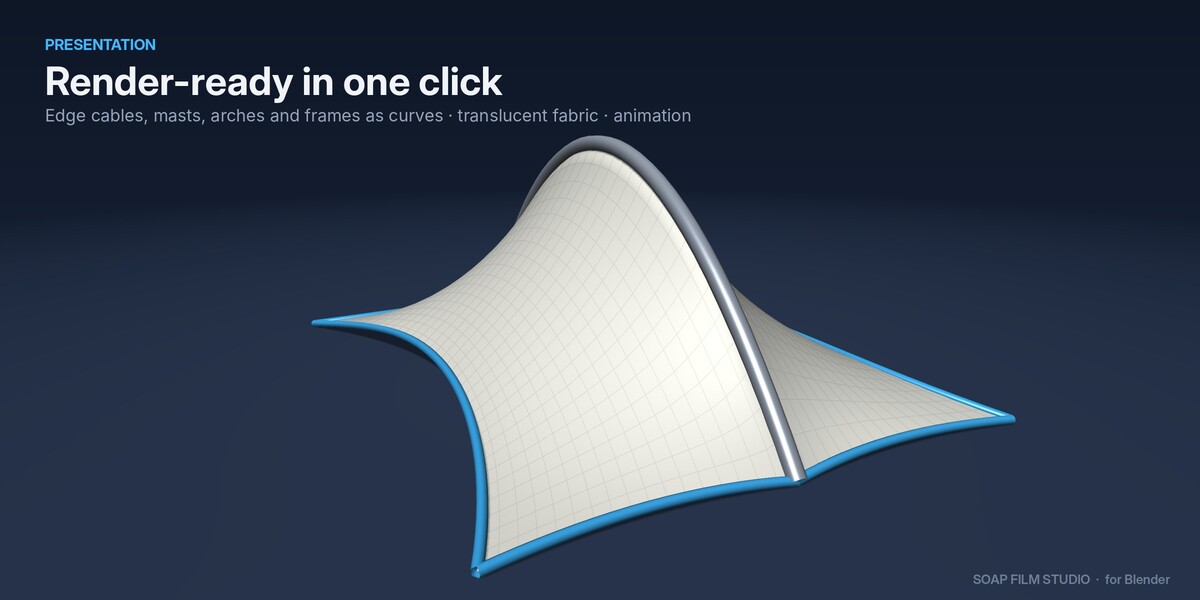
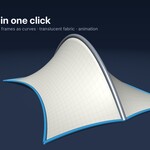
- Build Render Rig: steel curves for the edge cables, masts under raised point anchors, a central mast for small mast-head rings, tubes along arches and frames, a Solidify modifier for fabric thickness, and a translucent fabric material. The parts are parented to the membrane and rebuilt cleanly if you click again.
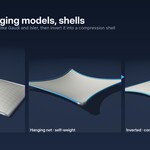
- Invert (Hanging to Shell): mirrors a hanging model about its supports. The tension form becomes a compression form (Gaudí, Isler).
- Animate Form-Finding: shape-key animation from the start shape to the found form over the chosen number of frames, ready for presentations. Clear Animation removes it and keeps the form.
5. Using your own geometry
- Model any mesh with faces: a grid, a filled outline, a tube… Triangles, quads and n-gons all work. Even, medium density works best (500 to 15,000 vertices).
- Pin the anchors. Move them where the structure needs them (mast tops, ground plates, beams).
- Find Form. Adjust the cable tension, then solve again.
- For gridshells or hanging nets: Cable Net + Self-Weight, then Invert.
Object rotation and scale are respected (gravity is always world −Z). Patterns and reports use world units, scaled by Scene › Units › Unit Scale.
6. Troubleshooting
| Message | Fix |
|---|---|
| No anchors | Assign anchors, or use Pin Boundary or Pin Corners. |
| This membrane has shape keys | Click Clear Animation in Presentation. |
| The solver diverged | Lower the pressure or self-weight, reduce the Step Size, or add anchors. |
| Film pinched | See above: no minimal surface exists. Switch to Cable Net or change the anchors. |
| Panels distorted (> 3%) | More panels, or cut along the other direction. |
| Nothing shows in Analysis | Use Solid view. The colour is set to Attribute automatically. |
7. How it works
- Soap film: iterative minimisation of the surface area with cotangent weights (Pinkall & Polthier, 1993) and fixed anchors. The catenoid preset matches the analytical solution within 0.3%.
- Cable net: force density method (Schek, 1974).
- Edge cables: constant tension T. In equilibrium with surface tension σ they form circular arcs of radius T/σ.
- Loads: pressure and self-weight are re-evaluated on the current geometry at every iteration.
- Solver: Jacobi-preconditioned conjugate gradient in pure NumPy, vectorised over x, y and z. A 10,000-vertex membrane solves in seconds.
8. License & support
Soap Film Studio is free software under the GNU GPL v3 or later (see LICENSE), as required for
Blender add-ons. Your purchase supports development and includes updates.
Questions, bugs and feature requests: use the Superhive product page (Questions / Support tab). Please include your Blender version and, if possible, a small .blend file.
Have questions about this product?
Login to message
| Blender Extension Compatible | Yes |
| Published | about 5 hours ago |
| Blender Version | 4.2 - 5.2 |
| Extension Type | Add-on |
| Render Engine Used | Cycles, Eevee |
| License | GPL |
Discover more products like this
form finding cable net etfe canopy tent soap film cutting patterns minimal surface tensile structure shell membrane architecture