Do People Only Buy During Sales? Here’s What the Data Says.
-
 Written by Kyle Maurer
 Written by Kyle Maurer
For ten years now our team at Superhive (formerly Blender Market) has carried on a practice of coordinating large scale sale events throughout the year. If you’re curious about the philosophy behind these events, you may also enjoy Why Do We Run Sales on Superhive. These events have varied a small amount such as the discount amount, number of days, exact dates, etc. But for the most part we have been consistent in our one-sale-per-quarter cadence for years.
This consistency has given us a lot of interesting comparative data to analyze and learn from. From an analytical perspective, rinsing and repeating is great because we can make apples to apples comparisons year after year. It’s easier to spot trends and quantify the impact of changes when events follow a similar pattern.
At Superhive we are always striving to improve and better support Blender artists and developers. We believe we have a duty to study our data, listen to the stories of the people we serve, and make informed decisions in everyone’s best interest. We try not to take anything for granted and we question everything.
Others have questions too. On many occasions, we’ve had customers and creators express concerns and preferences to us regarding our seasonal sales. Some have pushed for sales to happen more often, but more often creators specifically have spoken out against frequent sale events. The concern is that too many sales will lead to customers changing their buying behavior. Customers can be trained to wait for sale events and eventually stop making purchases when there aren’t sales.
It’s not an irrational concern. Many cautionary tales exist about major brands slowly devaluing their offering by discounting to the point at which customers essentially stopped purchasing at full price. Famously, brands like Gap and JC Penney dug themselves into deep holes through discounting practices which permanently altered their brand perception and position.
A relative of mine was a high ranking executive at JC Penney during their disastrous attempt to reverse course from living off coupons and sales almost a decade and a half ago. He witnessed firsthand how virtually impossible it is to restore a brand’s image as premium when discounted selling was the modus operandi for years. They are now a textbook example of how easy it is to become overly reliant on coupons, discounts, promotions, etc. to drive sales.
Is this a concern for Superhive? Is the consistency and regularity of our sale events training customers to become bargain hunters and sale-only shoppers? Are we doing our creators and customers a disservice by over-discounting? Is “sale fatigue” a real danger for this marketplace?
Those are never easy questions to answer but I’m looking to try and tackle them to the best of my ability today. Let’s find out what the data shows!
Jump to a Section
- Key Takeaways
- Segmenting customers by buying patterns
- Examining daily revenue prior to a sale event
- Full price vs discounted price purchases over the years
- Average daily sales multiples during sale events
- Conclusion
- FAQ
Key Takeaways
- Only 0.4% of multi-purchase customers over the past three years bought only on-sale items.
- Only 0.3% of customers during that period purchased 70%+ of their items on-sale.
- Daily revenue before Cyber Sale events generally does not show meaningful evidence of customers holding off for discounts.
- More than 75% of purchases each year still happen at full price.
- Sale events remain significant, but their impact relative to normal periods has gradually declined.
Segmenting customers by buying patterns
The first thing I’m looking at is how many of our customers appear to be conditioned to buy only when there are sale events. I looked at all customers for the past three years to group them based on their propensity to buy on-sale items vs regular price items. I broke them into four groups:
- Sale only - Customers who have made multiple purchases but never buy anything that isn’t on sale.
- Mostly sale only - Customers who have some regular priced purchases but do 70%+ of their shopping during sale events.
- Year round - Customers who routinely make purchases regardless of sales.
- Single purchase - Customers who’ve only ever made one paid purchase and therefore have no behavioral pattern we can study.
Hypothesis: Excessive formulaic sale events are training customers to stop buying regular price products. This would be proven by a high, increasing number of customers making purchases only during sale periods.
Is this happening?
No.
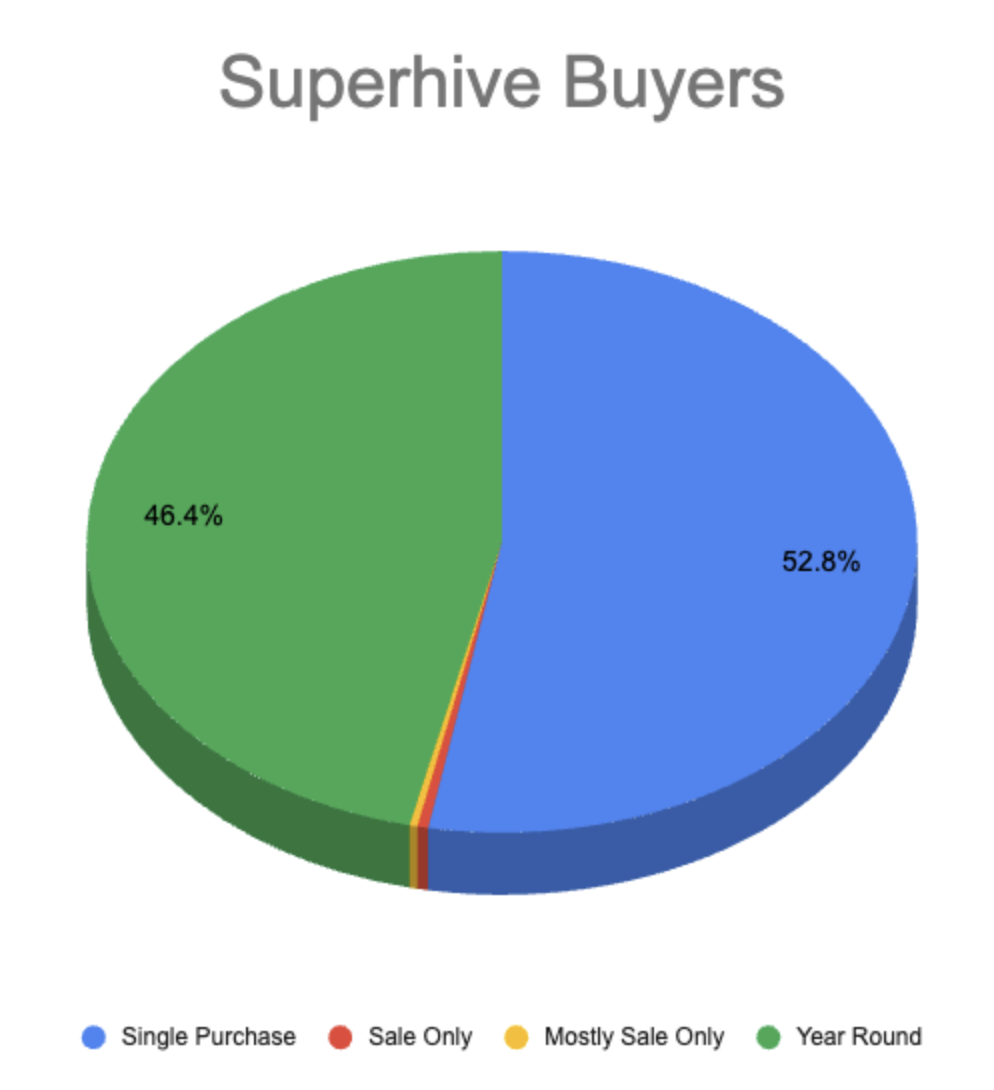
0.4% of multi-purchase customers over the past three years bought only on-sale items. 0.3% of customers during that period purchased 70%+ of their items on-sale.
It does not appear that Superhive has a serious problem of customers refusing to buy when products are not on sale. Those customers do exist but they represent an extremely small fraction of our audience. Overwhelmingly, customers who are making regular purchases at Superhive do so without waiting for a discount.
Note: That big slice of single-purchase customers will be the subject of another deep dive someday. That’s another area we need to be working on!
Examining daily revenue prior to a sale event
Another angle I’m exploring is how much overall sales are affected by an imminent discount event. In other words, I want to see if customers tend to slow down their spending when they know a sale event is approaching. Perhaps customers who want something on Superhive tend to think they can save a few bucks by waiting another week or two when the item will likely be discounted. Our buyer’s guide for 3D hobbyists, freelancers, and studios explains how many customers approach purchases on the marketplace.
To understand this, I am specifically looking at our annual Cyber Sale. This is because it is the one sale which all customers can reasonably count on and predict. We never go out of our way to tell customers the dates on which sale events will occur, but for the last sale of the year we really don’t have to; everyone knows it will start on Black Friday (the day after Thanksgiving in the United States) and go through at least Cyber Monday.
Additionally, this is the sale event we have repeated the greatest number of times going all the way back to 2016. For the purpose of this study though, I am only looking back as far as 2019 when we started formally tracking sale events in our database.
I am choosing to exclude the other seasonal events from this examination because: 1) Customers generally do not know when and if they will occur and so their buying patterns are less likely to change, 2) We have not been as consistent with the particulars of those other seasonal events, and 3) I have looked at the comparative data for those sales anyway and observed very little of interest.
Hypothesis: Many customers are choosing to spend less or delay purchases in time periods immediately preceding a major, known sale event. This would be confirmed by the observance of significant revenue declines in the days and weeks before a sale event begins.
Is there evidence of this happening?
No.
Take a look at this chart in which I averaged and flattened the daily revenue numbers for the last seven Cyber Sales:
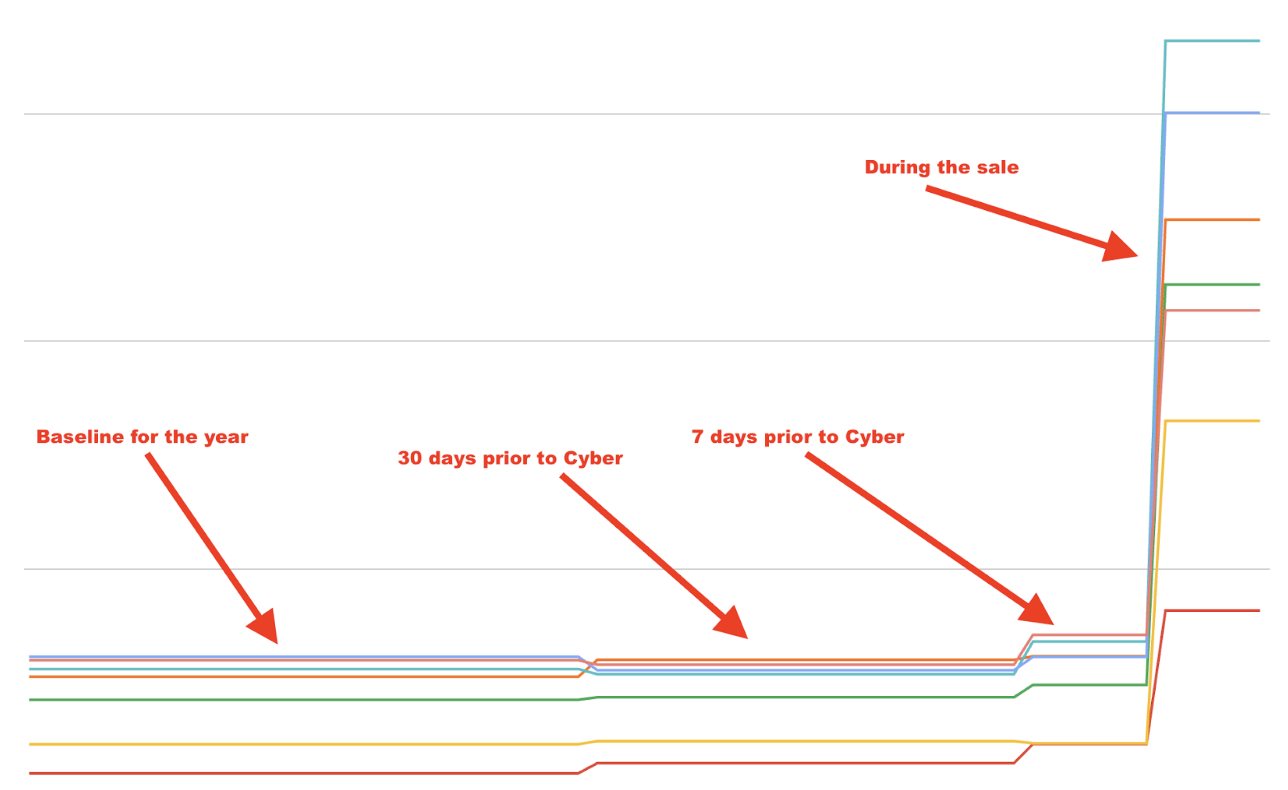
That visual may be a little hard to follow because there are so many lines close together. But if you look closely, you will see that the averages in the time periods preceding sale events fluctuate a little but not dramatically. You’ll also see that the lines go up (meaning increased average daily sales) more often than they go down.
I find these results fascinating. Here are some nuggets:
- In only ONE of these years (2024) did the average daily sales amount go down below the yearly baseline for the week prior to the Cyber sale and it only went down 0.2%! Every other year the number went up. That means we are consistently seeing higher purchasing activity than the norm for the year in the days leading up to our biggest annual sale. This is surprising because, in theory, those customers would only need to wait a couple more days to benefit from our largest annual discount event. But they don’t wait. In fact, they buy more.
- The last three years have all shown decreases from the yearly baseline over the 30 day period leading up to Cyber. This could suggest a trend toward greater customer awareness of the Cyber Sale’s imminence given our consistent patterns. However, those decreases have been modest each time (between 3% and 9% difference from the baseline) and don’t strike me as evidence of any large scale change in customer tendencies.
It appears that customers delaying their purchases until sale events come around is not a Superhive problem.
Full price vs discounted price purchases over the years
When considering how significant our repetitive sale event strategy has been, it’s important to look at how the numbers have been changing each year to spot trends. One dimension I’ve been curious about is the percentage of purchases which are completed for full price vs those completed at a discounted price.
Discounts on Superhive are accomplished through coupons, sale events, and (as of summer 2025) bundles. I thought it could be useful to illustrate how much discounted purchases are as a share of the total annual sales and to see if that share is increasing with time.
Hypothesis: The prevalence of available discounts on Superhive products is reducing customer willingness to pay full price. This would be confirmed by observing a consistent increase in the percentage of total sales which were made at a discount (using coupons, sales, and bundles).
Is this a real problem for us?
Mostly no.
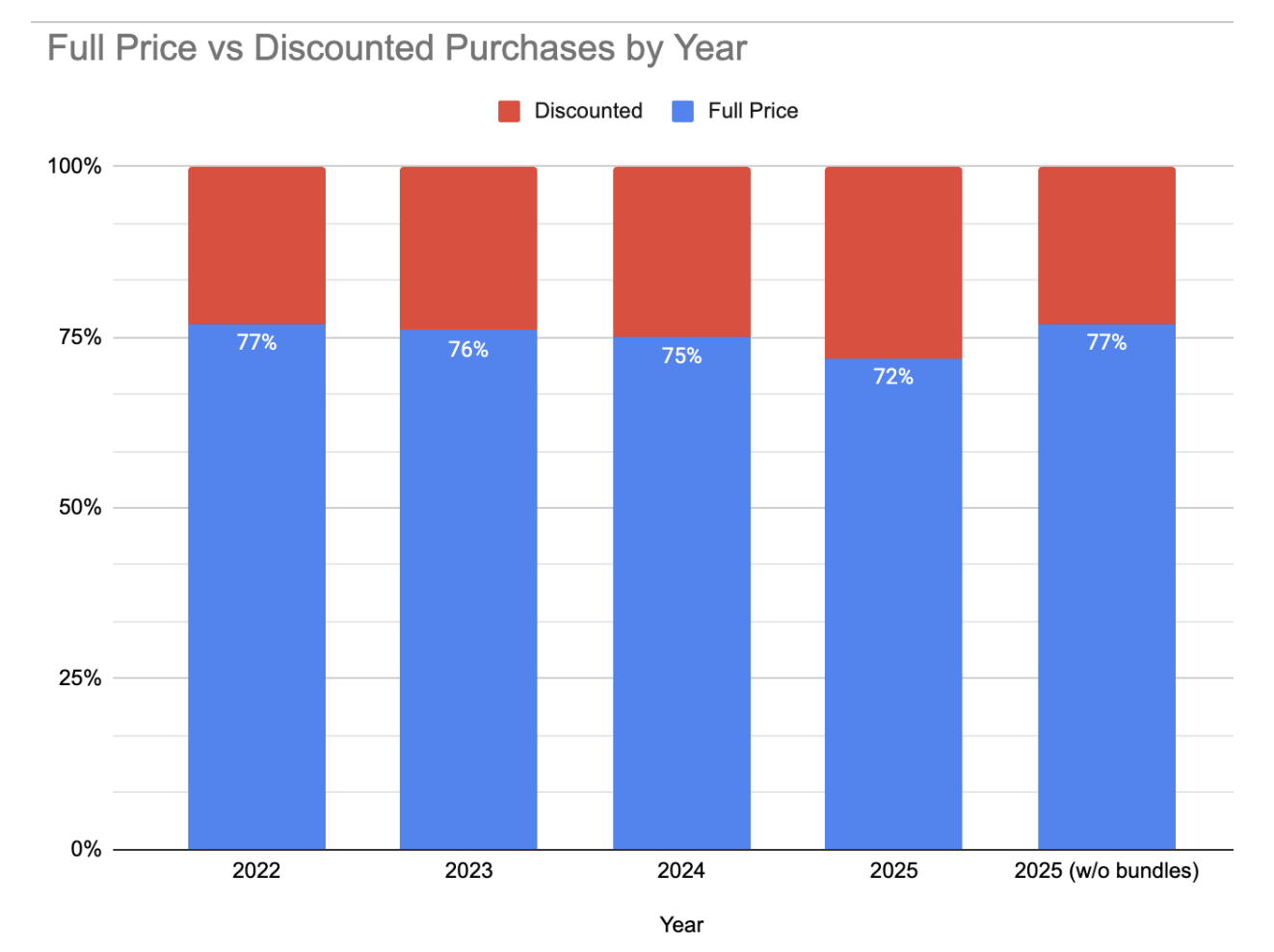
Here’s a breakdown of the past four years looking at all paid purchases and grouping based on whether a discount was used:
A few thoughts on what we see here.
First, I’d generally feel pretty good about a lot of businesses which maintain a >75% full price purchase ratio year after year. If only a quarter or less of your sales each year come at a discounted price, you are probably nowhere close to becoming a discount brand, living and dying by promotions and sale events. I actually like what I see here.
Second, there is a trend of the discounted purchase share increasing by 1% for three straight years. That’s a small amount but is still worthy of some concern. Digital marketplaces like Superhive are very susceptible to races to the bottom wherein competition drives prices down and sellers must get aggressive with their offers to earn any sales. I’m always watching for signs of that problem and this slow trend has my attention. We recently explored this broader issue in more depth in The Blender Creator Economy Is Breaking – Let’s Start Talking About It.
However, as illustrated in the fifth column above, the increase for discounted purchases last year is largely due to our introduction of product bundles. Bundles are a new addition to Superhive and have proven to be quite popular. Overwhelmingly, bundles were a huge net positive for the marketplace. They were well received by customers and drove substantial new revenue for participating creators. However they technically represent item purchases at less than retail prices. When those purchased items are excluded, we find ourselves with the 77%/23% split we had back in 2022.
On the one hand, the overall share of items being purchased at a discounted rate did increase more than the usual amount last year which is not a trend we want to see. But that was in large part due to a brand new type of discount (bundles). If those are excluded, we end up with a discounted purchase share that is equal to our all-time low.
Average daily sales multiples during sale events
Every sale event we have ever orchestrated has resulted in an increase in sales per day relative to the period preceding it. But is the degree of increase changing over time?
To understand this I am looking at the difference between the average daily sales during a sale event and the daily sales average for the 60 days preceding that same event. I’m expressing that difference as a multiple of the baseline. For example, if average daily sales during the 60 days preceding a sale were $1,000 per day and then during the sale they were $2,000 per day, that would be a 2x multiple.
The concern is that increases in these multiples could indicate customers by and large are preferring to buy during sale events and less during normal periods. Brands which heavily rely on sales and promotions tend to see these multiples go up over time.
Hypothesis: Our frequent, large scale sale events are training customers to shop only when sales are active and not during normal periods. This would be confirmed by measurable, consistent increases in average daily sales multiples when comparing events to the periods preceding them.
Is this a problem we are experiencing?
No, we appear to have a different problem.
Take a look at this chart showing the multiple for every sale campaign we have run since 2019:
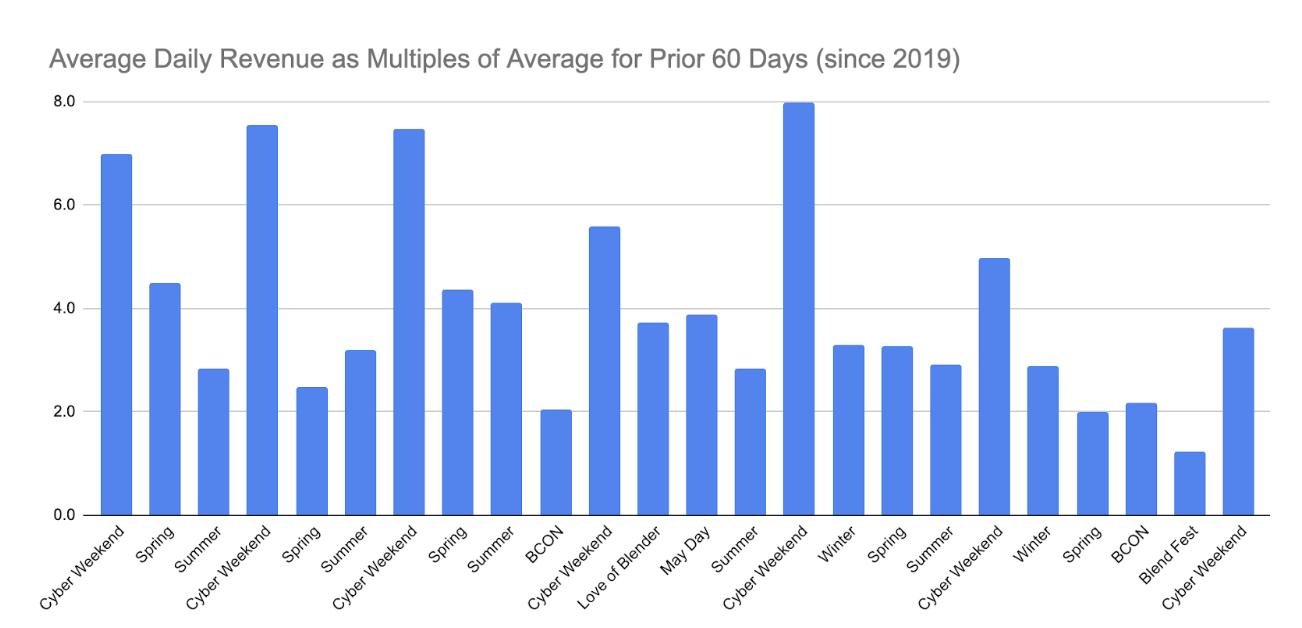
In this chart, again, we see the multiple for each sale’s average daily earnings compared to the 60 days prior. Our highest on record was our Cyber Sale in 2023 which earned 8x per day more than the average for the preceding 60 days. Our lowest on record was last year’s October Blend Fest which brought in 1.2x more on average per day than the 60 days prior.
I’d note that Blend Fest was not a conventional sale event like the others in that it was a coordinated series of unique promotions over a longer span of days. The fact that its multiple was lower than the other sitewide discount events makes sense given how different it was in format and purpose.
Looking at this data, my assessment is that we are not seeing customers shift their buying habits to sales only. In fact, the opposite is true. Sale events are still very significant for Superhive, however the trend is a gradual decline in their difference from normal sale periods. We are witnessing sitewide sale events decrease in their impact.
On one hand, it can be taken as a healthy sign that overwhelmingly, discounts and deals are not necessary for customers to be willing to spend their money. Our customers appear to consider the pricing reasonable and the value high for items sold on Superhive. Sale events clearly do accelerate purchasing and increase the amount that customers spend but there is no sign suggesting customers are unwilling to pay regular price during the rest of the year.
However, the slow decline in sitewide sales impact is something we are studying further and looking to improve upon. We do not want this trend to continue and are exploring many ways to restore the significance of these major sale events.
It is unclear exactly all the reasons that, proportionally speaking, sitewide sale events are not hitting as hard as they used to. Theories are abundant. Are customers bored with the same ol’ thing? Are the discount amounts large enough? Are we promoting the right products during the sales? Are we reaching the right customers with our sale event marketing? Is our much larger catalog making it harder for customers to find what they need/want? Customers can also explore several built-in discovery tools described in Four Ways to Discover More on Superhive . Are we introducing enough new, innovative, exciting products or is it too much of the same? Has the rebrand from Blender Market to Superhive been detrimental?
Ultimately, the role our sale events play has slowly evolved over time but not in a way which is harmful. If our new prerogative ends up simply being “make our sale events more exciting and compelling” then that is very much within our capabilities and we’re up for the challenge.
Conclusion
Quite often when embarking on investigative journeys like this, I find myself ending up with more questions than when I started. This analysis is no exception. I am eager to dive further into the questions in the final section above about the slowly declining sale event impact. I want to have a much better handle on our longstanding issue with so many customers being one-time buyers. We can and will examine these matters closely and do everything we can to develop effective strategies to get even better results in the future.
For now, I am pleased with what the data tells us: When it comes to sales and discounts, Superhive is healthy and strong.
Stay tuned for more and happy Blending!
Kyle Maurer
(Director of Product and Ops)
FAQ
Do frequent sale events train customers to only buy discounted products?
Based on this analysis, no. Only 0.4% of multi-purchase customers over the past three years bought only on-sale items, and only 0.3% purchased 70%+ of their items on-sale.
Do customers hold off on buying when a major sale is approaching?
According to this study, not in any significant way. In most years, average daily sales actually increased in the period leading up to the Cyber Sale.
Are most Superhive purchases still made at full price?
Yes. More than 75% of purchases each year still happen at full price, which suggests Superhive is not operating like a discount-dependent brand.
Are sale events becoming less effective over time?
They are still significant, but their impact relative to normal sales periods has gradually declined. That appears to be a more relevant issue than customers becoming sale only shoppers.