 Hugu's Works




🎉 Early Bird Offer: $10 for the first 50 buyers!
Get Blend Mol at the launch price during early release. Price will increase as major features (electrostatics, transition metals, conformer search, and additional display styles) are added.
What is Blend Mol?
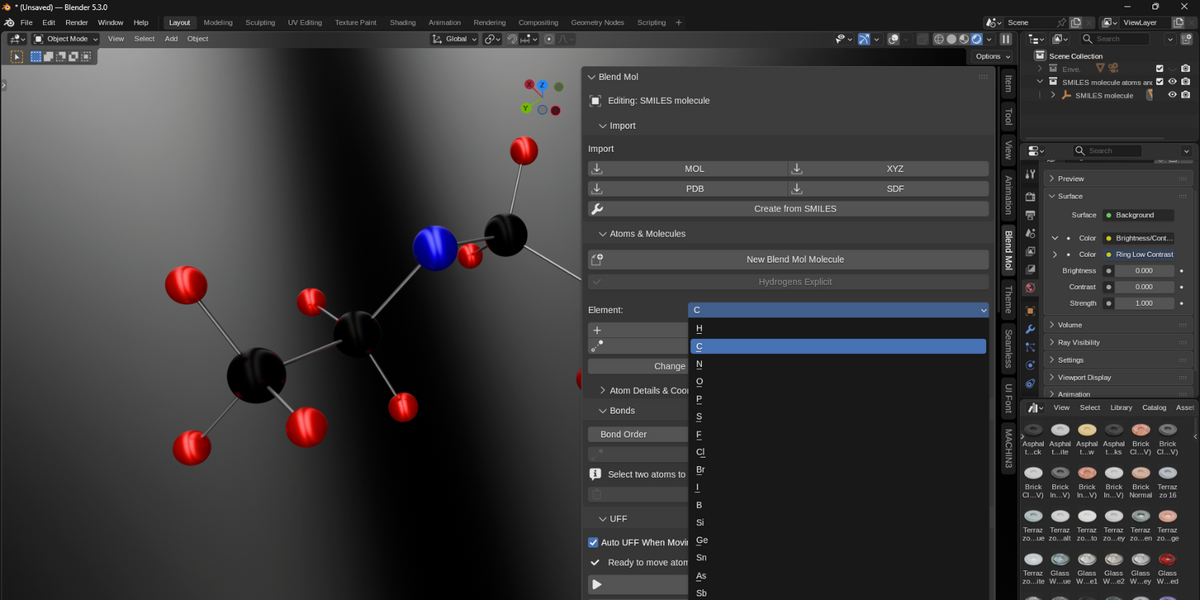
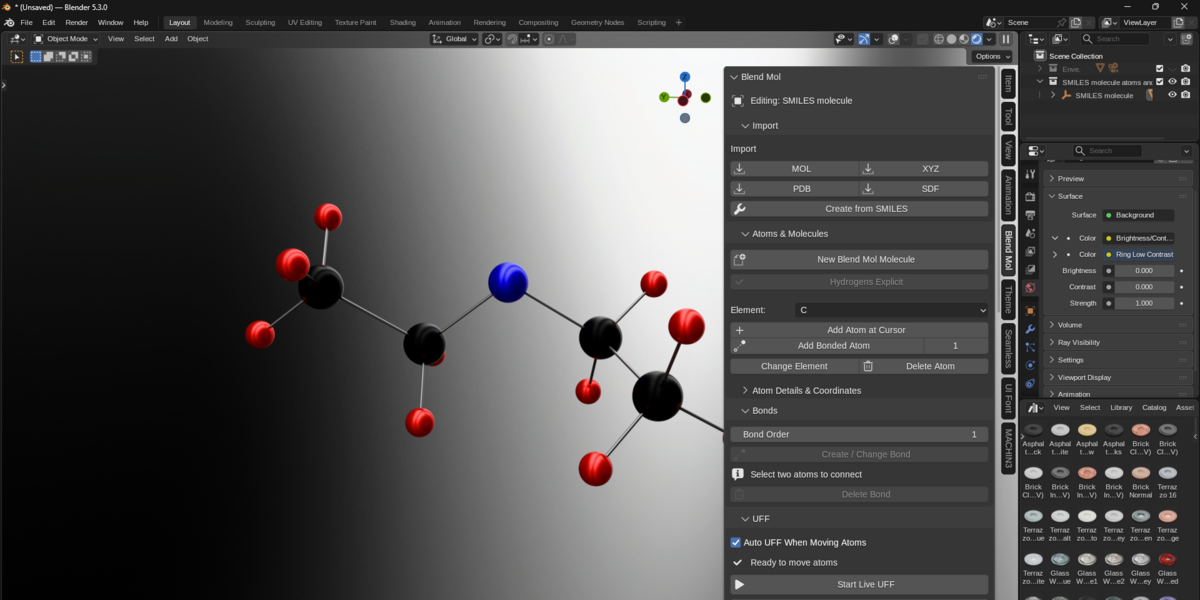
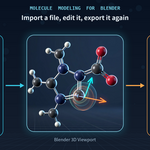
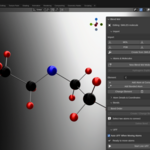
Blend Mol is a Blender 5.2+ extension for building, editing, visualizing, and UFF-optimizing molecules directly inside the 3D Viewport—with zero external dependencies (no Open Babel, RDKit, or Python package installation required).
Whether you are a chemist, researcher, educator, or science illustrator, Blend Mol lets you go from a SMILES string or chemical file to a physically relaxed 3D ball-and-stick model in seconds, or build and sculpt molecules atom by atom in real time.
Key Features
1. Real-Time Interactive Live UFF & Geometry Optimization
-
Auto Live UFF on Atom Move: Simply grab and move an atom (
G) and surrounding atoms relax smoothly in the background—then stop automatically once settled. -
Non-Blocking Background Solver: UFF calculations run on a dedicated background worker thread so Blender's UI stays responsive. Press
Escor right-click to cancel and restore the session's starting coordinates. - Three Optimizers: Stateful L-BFGS (default), FIRE2, and Steepest Descent, preserving momentum/curvature history across interactive updates.
- Rust Native Acceleration + Python Fallback: Includes a multi-threaded Rust kernel for van der Waals and numerical torsion/inversion gradients, with automatic fallback to the pure-Python reference solver.
- Partial UFF Force Field: Evaluates bond stretch, angle bend, torsion, out-of-plane inversion, and van der Waals terms (cross-checked against Open Babel 3.1.1).
- Constraints & Pinning: Pin fixed atoms and add harmonic distance, angle, and dihedral restraints.
2. 3D Structure Generation from SMILES (Zero Dependencies)
- Built-in 3D Distance-Geometry Embedder: Generates 3D starting conformations directly from SMILES—including chair six-membered rings, planar aromatic rings, and linear sp centers (2D flat layout is also available as an option).
-
Stereochemistry Support: Honors tetrahedral (
@,@@,@TH1,@TH2) and E/Z double-bond (/,\) stereo marks. -
Extended Syntax: Supports aromatic Kekulization, isotopes (e.g.,
[13CH4],[2H]O[2H]), formal charges, bracketed silicon, and wildcard placeholders (*).
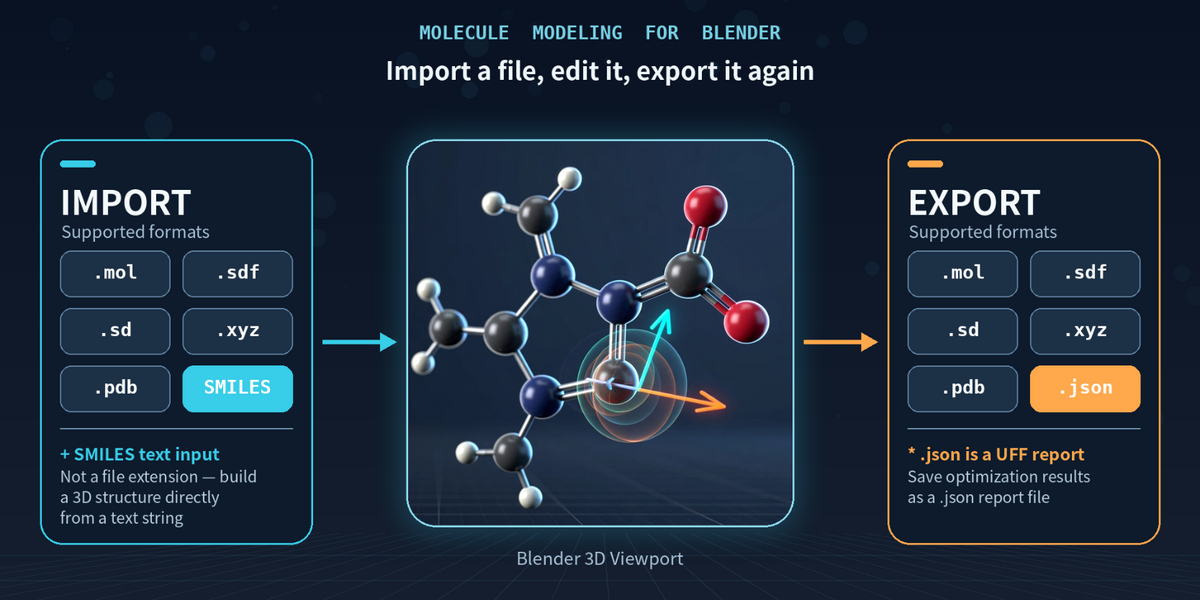
3. Chemical File Import & Export
-
MDL MOL (V2000 & V3000): Imports and exports atom coordinates, bond orders, formal charges (
M CHG), isotopes (M ISO/MASS=), and converts aromatic bonds (order 4) to Kekule single/double patterns. - SDF (Multi-Record): Batch-import multiple records arranged neatly in a row while preserving SD data items, and export multiple selected molecules to a single SD file.
-
XYZ & PDB: Imports and exports coordinates and PDB
HETATM/CONECTconnectivity, with optional distance-based single-bond perception for XYZ and CONECT-less PDB files. - UFF JSON Report: Export atom types, per-term energies, constraints, and minimization logs as JSON.
4. Intuitive Atom & Bond Editing in Blender
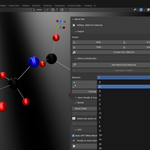
- Build from Scratch: Start an empty molecule at the 3D cursor, add atoms, or add bonded atoms directly in one click.
- Smart Valence Handling: Automatically replaces spare explicit hydrogens when adding a single, double, or triple bond to a saturated atom, while guarding against invalid over-valence edits.
- Full Edit Controls: Change elements, set formal charges, toggle/delete bonds, batch-delete selected atoms (with automatic constraint re-indexing), and make implicit hydrogens explicit in one click.
5. Customizable Display & Materials
- Live CPK Palette & Materials: Adjust per-element colors, Roughness, and Metallic sliders with instant viewport updates across Blend Mol objects.
- Mesh Controls: Customize atom scale, bond radius, sphere/cylinder tessellation, and add non-destructive Subdivision Surface modifiers.
- Recovery Tools: Save/restore coordinate snapshots, compare Before/After UFF minimization states, and use emergency Jitter to escape degenerate collinear geometries.
Supported Elements & Current Scope
To keep expectations clear, here is what Blend Mol v0.1.92 currently supports and what is still on the roadmap:
| Area | Current Support (v0.1.92) |
|---|---|
| Blender Version | Blender 5.2 or newer (Extension format) |
| Elements (18) | H, C, N, O, F, P, S, Cl, Br, I, B, Si, Ge, Sn, As, Sb, Se, Te |
| Force Field | Partial UFF (bond, angle, torsion, inversion, vdW). No electrostatic/Coulomb terms yet. |
| SMILES Stereo | Tetrahedral (@, @@, @TH1, @TH2) and double-bond (/, \). Allene/square-planar/octahedral stereo tags are not supported yet.
|
| Live UFF Undo | Canceling with Esc/right-click restores the session's starting coordinates (not per-drag history). |
Platform Compatibility & Included Files
-
Windows (x64): Tested with Blender 5.2+ & includes native Rust DLL (
blend_mol_uff.dll). -
Linux (x64): Headless-verified in CI with Blender 5.2 & includes native Rust shared library (
libblend_mol_uff.so). -
macOS (Apple Silicon & Intel Universal): Includes compiled Universal library (
libblend_mol_uff.dylib) and pure-Python fallback. Note: macOS native library is currently unsigned and awaiting real-world user feedback; if blocked by macOS security, Blend Mol automatically falls back to the built-in Python solver.
You can install the All-in-One ZIP (works on all supported OSes) or choose your OS-specific package via Edit → Preferences → Get Extensions → Install from Disk.
Roadmap
- Electrostatic interactions (QEq partial charges + Coulomb term)
- Transition metal UFF typing & manual type overrides
- Conformer search & per-drag Live UFF undo
- Additional display modes (space-filling / VDW, wireframe, ribbon) & CIF / Cube support
License: GPL-3.0-or-later