 Synapse Nodes
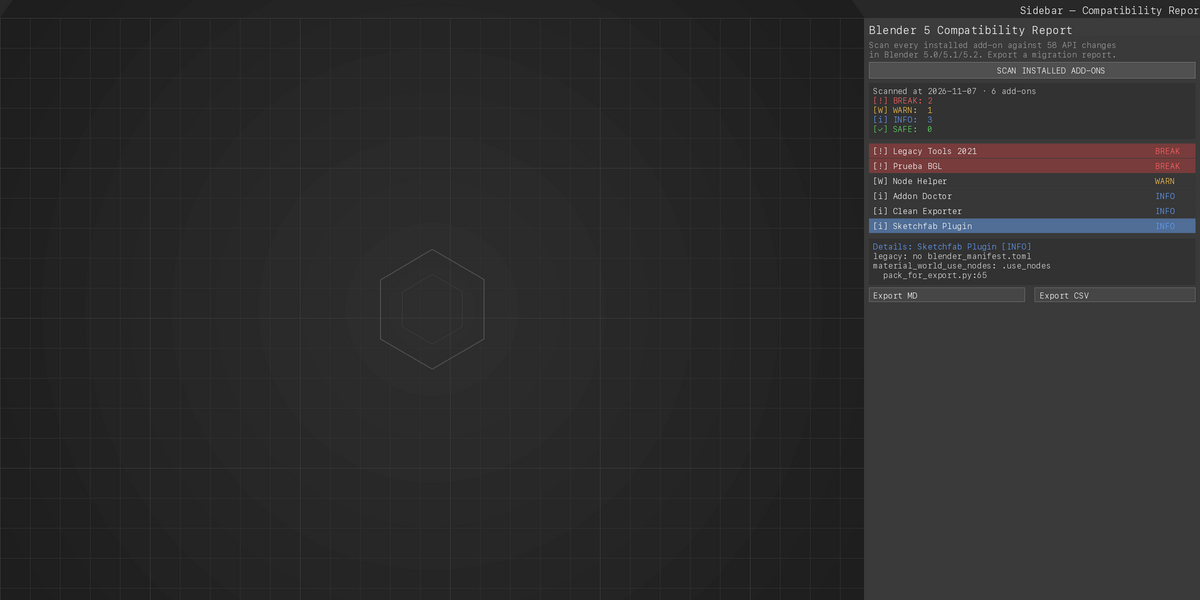
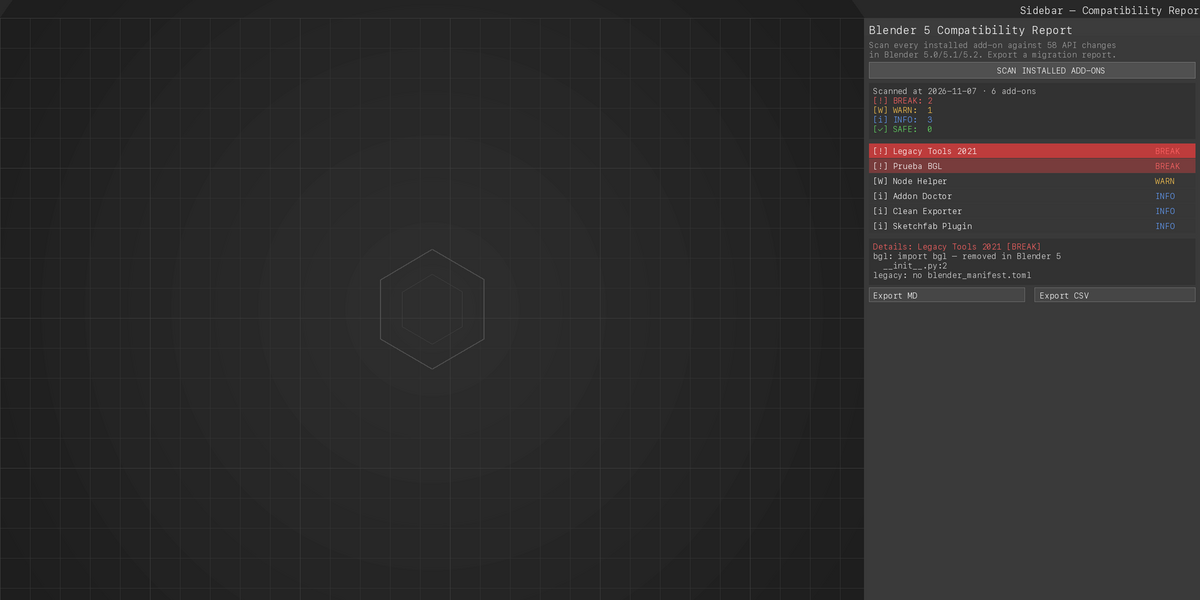
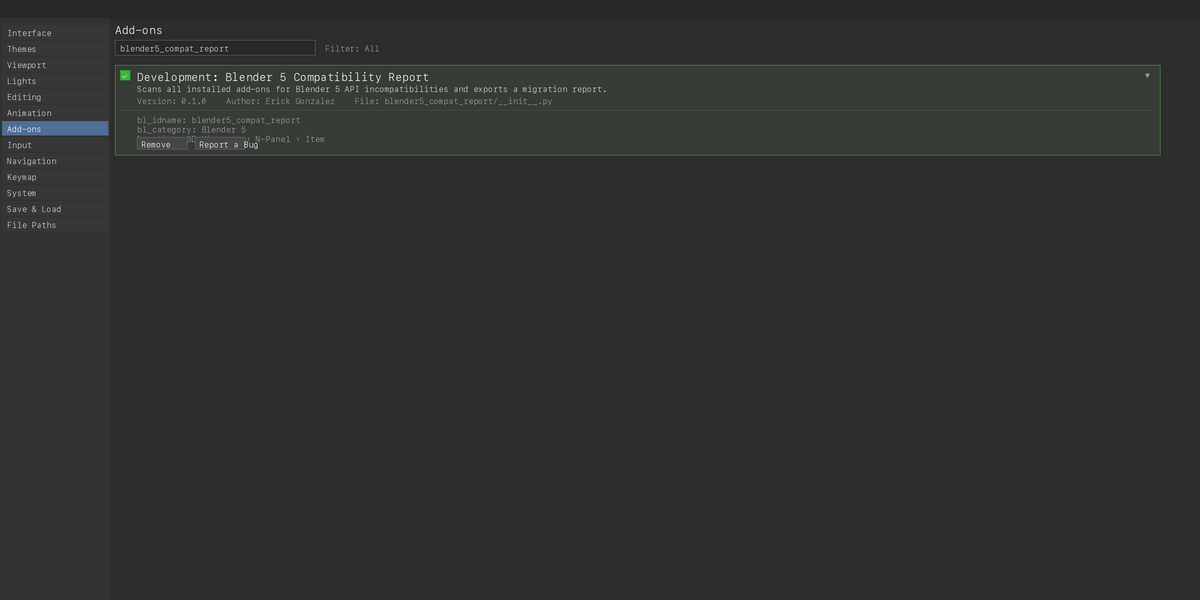
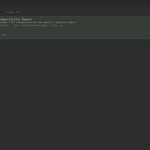
Blender 5 Compatibility Report scans every add-on and extension installed in your Blender against 58 API changes introduced in Blender 5.0, 5.1 and 5.2 — before you update.
How it works
- Open the 3D Viewport sidebar (N) and pick the Blender 5 tab.
- Press SCAN INSTALLED ADD-ONS. Each add-on receives a verdict: BREAK, WARN, INFO or SAFE.
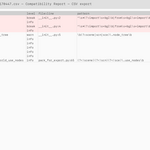
- Select an add-on in the list to see its findings. Press EXPORT MD or EXPORT CSV to save the full migration report to ~/Documents.
It reads the files of every installed add-on without importing or running them.
What it checks
- 58 rules covering Python APIs that were removed, renamed or changed behavior in the official Blender 5.0, 5.1 and 5.2 release notes (for example scene.node_tree, BLENDER_EEVEE_NEXT, brush.use_airbrush, modifier['Input_2']).
- Three levels: rompe (3 rules), revisar (53 rules), info (2 rules).
Verdicts
- BREAK: at least one rule with level rompe matched — the add-on will not install or enable in Blender 5, or fails while loading.
- WARN: at least one rule with level revisar matched — it probably loads, but some features may fail.
- INFO: only informational rules matched — worth reading but unlikely to break.
- SAFE: nothing from the list was found. This is not a guarantee.
Export
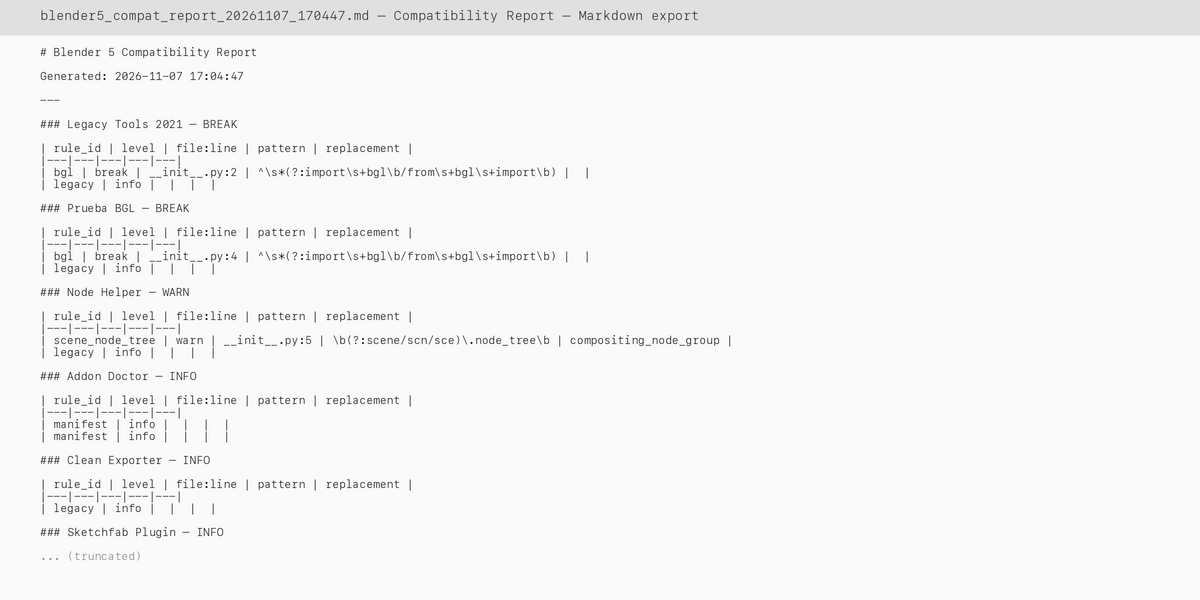
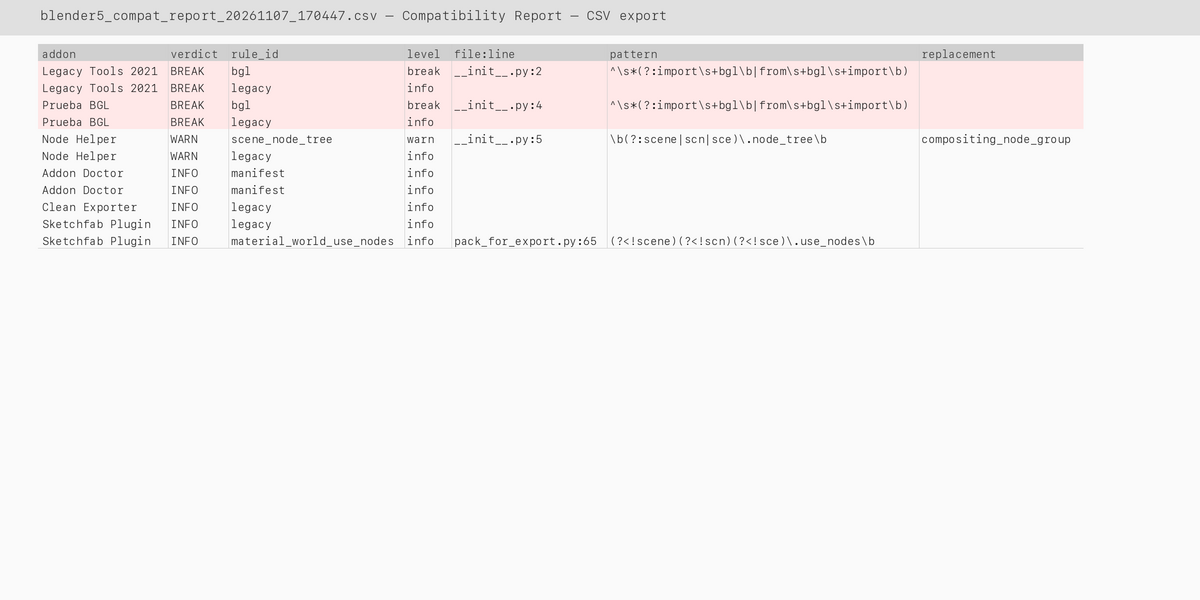
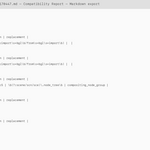
EXPORT MD writes a Markdown file to ~/Documents with a summary table and a per-add-on detail table (rule_id | level | file:line | pattern | replacement). EXPORT CSV writes the same data as a plain CSV, one row per finding.
Good to know
- Read-only: no internet access, no telemetry, and it never changes your other add-ons. The add-ons bundled with Blender are skipped.
-
Static analysis: it cannot see version checks such as
if bpy.app.version >= (5, 0, 0), so false positives are possible. The report gives file and line so you can check each finding. - Compatibility: Blender 3.6 to 4.1 as a legacy add-on, and 4.2 or newer as an extension. Both downloads are included.
Tested
Tested by hand in Blender 3.6 on macOS: load, enable, scan of a minimal folder, EXPORT MD and EXPORT CSV.
AI disclosure
AI-assisted: the first draft of the code was generated with Claude, an AI coding assistant by Anthropic. The scanner and rules were reused from Addon Doctor (same author). I reviewed, tested and adapted everything.
