H-Point: Package Builder
 Curb Industries


# H-Point: Package Builder, v1.9.1 Release Notes
**Curb Industries, INC.** · September 2026
---
## Overview
A fix release. Two things surfaced in a live demo, and one control that could quietly
freeze every slider in a file is gone.
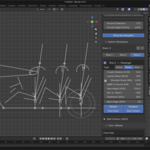
## Front-row occupants at two heights
Turning **Symmetric** off and back on could bring the passenger back at a different
height from the driver. It happened only on a package whose tire had been resized after
it was built.
Every occupant is placed at its H5 above the road the package was built on, and then
stays put while a bigger or smaller tire moves the road. An occupant created *after*
the tire changed (the passenger mirror when Symmetric comes back on, a 3-across centre
seat, or an occupant rebuilt because its manikin type changed) was being placed on the
current road instead. The two seats then sat half the tire-diameter change apart.
Every occupant now uses the package's original road, however late it is added.
**Files saved with the problem are repaired when they open.** Any occupant sitting on a
different road from the row 1 driver is brought back level with it. A file without the
problem is not touched.
## Ankle Angle
The passenger and rear-facing occupant's **Foot Angle** control is now **Ankle Angle**.
It reads the angle between the shin and the sole, the same relationship the driver
holds at 87° on the accelerator (SAE J826 §4.3.2.2). A passenger foot in the driver's
foot-to-shin relationship now reads 87° too.
Type a value and the foot rotates about the heel until the ankle reaches it. The range
you can reach runs from 87° (toes up, at the J826 stop) to the flat foot, and it moves
with Hip-to-Heel and Seat Height: the further out the feet, the more the toes can lift.
A value outside that range settles at the nearer end. If Hip-to-Heel is tucked in so
far that even a flat foot is under 87°, the panel says so.
This also fixes the direction. In v1.9.0 a positive Foot Angle rotated the toes *down*,
through the floor. They now lift.
**If you used Foot Angle in v1.9.0:** a flat foot (0, the default) is unchanged. A foot
you rotated will now lift instead of dropping, and may stop at the 87° limit sooner
than the number you set. PKG files carry the same stored value as before and import
unchanged.
## Auto Update removed
The **Auto Update** toggle and the **Update** button are gone from the main panel. With
Auto Update off, every slider and field in the package stopped doing anything, with
nothing on screen to say why. Geometry always follows the panel now. A file saved with
the toggle off, or a PKG file that recorded it off, opens with it on.
---
*Approximation, not for production use. Validate all dimensions with your studio
engineer.*
v1.8.5
Change a tire, and everything measured from the road changes with it.
Fitting a taller tire used to move the whole vehicle envelope and leave ground clearance and overall height reading their old values. That was backwards. Both are measured from the road surface, so a taller tire raises them, and the body stays where you put it. It does now. Put a 900 mm tire under a package sitting at 100 mm of ground clearance and you will read 194 mm, with the occupant and the envelope untouched.
Aspect ratio now sizes the rim. Dragging aspect ratio used to resize the whole tire. The rim slider already worked the other way, holding overall diameter and letting aspect ratio follow. Both now behave the same. Take a 255/55R17 down to 45 series and you get a 255/45R19 at the same diameter, on a rim size you can actually buy.
Tandem packages get an axle-to-axle breakdown, in the tire panel: wheelbase measured between the two innermost tire centers, each overhang measured from the outermost center, and their sum. These are Curb dimensions and carry no SAE code, which is why they sit beside the tire controls. The wheelbase and overhang fields in the exterior panel keep the midpoint convention that SAE J1100 requires for dual rear axles, so both readings stay honest and they always agree on overall length.
Fixed
Door trim jumping to the centerline. Unlocking shoulder room, moving the lateral offset and re-locking could throw the door trim section onto the middle of the package, far enough in some cases that the driver and passenger trims swapped sides. Lateral offset (W20, the distance from the vehicle centerline out to the seating reference point) is a signed position only on an asymmetric row. Symmetric rows now hold it at zero or above, and shoulder room carries a physical minimum, so the two trims can no longer close through the occupant.
Shoulder room now carries the correct code. Rows behind the first were labeled W4, the code superseded in the 2009 revision. They now read W3-2 and W3-3, per SAE J1100 Table 17.
Removed
Seat track travel and wheel to PRP no longer appear in the interior panel. Both still feed the eyellipse construction exactly as before, so no geometry moves.
Existing packages open unchanged. Tested on Blender 5.2; the minimum supported version is still 4.2.
Improved Ctrl-Z functionality
You can now open your project in a Blender session that does not have the H-Point: Package Builder installed.
Full Release notes:
# H-Point: Package Builder, v1.8.4 Release Notes
**Curb Industries, INC.** · August 2026
---
## Overview
Bug fix for shared / portable files. If you sent a `.blend` to someone without the
add-on installed, the package did not stay put -- it collapsed. Tires shrank to
nothing, the ground plane dropped to the origin, and manikin posture reset to zero.
This release fixes that: a shared file now shows exactly the geometry you last saved,
whether or not the recipient has the add-on. If they install it, the package comes
back fully live and adjustable, same as before.
## What was actually happening
Blender re-evaluates every driver as part of loading a file. This add-on's dimensions
and manikin geometry are driven by scripted drivers that call functions the add-on
registers at runtime (things like tire radius and hip-point position). Without the
add-on, those functions don't exist, the driver expression errors, and Blender's
fallback for a failed expression is 0.0 -- which gets written into the object,
overwriting the correct number that was saved in the file.
## The fix
Every package driver is now muted immediately before the file is written and unmuted
immediately after. A muted driver is skipped entirely by Blender's evaluation --
whatever value is currently showing is what gets saved and what stays showing, with
zero risk of a missing function clobbering it. Opening the file with the add-on
installed unmutes everything again automatically, restoring full parametric control.
## Also fixed
Re-enabling the add-on on a file you already had open (without reloading it) now
fully restores live geometry, not just the correct numbers in the panel. Previously
this required a full file reload to take effect.
Undo (Cmd-Z) and redo now keep manikin-driven geometry -- hip point, knee/ankle/heel,
eyellipse, vision cone, BoF, torso -- in sync with everything else that reverts.
Previously, undoing a dimension change would snap the package anchor back correctly
but leave the manikin frozen at its pre-undo pose, since Blender's undo system has no
visibility into the internal function registry the manikin's drivers call. Undo and
redo now both trigger the same re-sync used on file load.
---
*Full per-change detail is in the CHANGELOG. See
docs/handoffs/2026-08-01-file-portability-driver-freeze.md and
docs/handoffs/2026-08-02-undo-redo-driver-resync.md for the empirical investigation
and root-cause writeups this release is based on.*
H-Point: Package Builder, Changelog
Curb Industries, INC.
Updates from v1.7.0 through v1.8.3, newest first. To pick up any geometry correction, rebuild the affected package (delete and re-create, or Update Geometry).
v1.8.3, July 2026
Race posture refinement. Road, passenger, and rear-facing manikins are unchanged.
- Race preset seating heights re-anchored to a clean descending ladder that matches the recline order: GT3 220 to 260 mm, Prototype 130 to 170 mm, F1 120 to 150 mm above the ground. GT3 sits highest, F1 lowest.
- Race head form is now circular. A race seat is fixed with a single design eye point, so the head and helmet now use the passenger manikin's rounder form instead of the fore-and-aft-stretched driver head. Rebuild race packages to see the change.
v1.8.2, July 2026
Bug-fix release closing a full codebase audit: twenty fixes, no new features, and no preset or dimension re-anchored.
- Race manikins seat at the exact height each preset names, with no extra road-car offset.
- Passenger and rear-facing rows now track their occupant properly: doors, head-to-bumper, floor reference, and the Show Manikin toggle.
- 3 Across seating anchors the center seat contour to the center occupant.
- Overall length stays consistent when the wheelbase or an axle is pushed to the length limit.
- Disabling a row hides the whole row and restores it exactly when re-enabled, and Add Row builds a complete row immediately from clean defaults.
- Re-locking the steering column angle recomputes it right away, and the Ground Clearance (H156) label and eyellipse toggle now show where they should.
v1.8.1, July 2026
Race Driver patch. No geometry, dimension, or preset changes.
- The race leg out-of-reach warning no longer fires on valid GT3 and F1 postures. It now checks the finished pose, so it stays silent for good postures and speaks up only on genuine over-extension.
v1.8.0, July 2026
New Race Driver manikin: a reclined competition-seating variant for single-seaters, prototypes, and GT cars. The existing DRIVER, PASSENGER, and REAR_FACING manikins are unchanged.
- Race Driver manikin type, referencing the SAE 95th-percentile body (J826 limbs, J1052 head) with motorsport posture rules. It reclines with an adjustable back angle, seats the hip as low as the floor, and can raise the heels above hip level.
- Posture presets GT3, Prototype, and F1, plus Custom, each referencing published FIA, LMH, and F1 seating figures, with single-seat placement per class.
- An adaptive race seat, a narrow race footwell with a Foot Spacing control, a free steering column angle, and race wheel shapes (a flat-bottom D for GT3, a squared butterfly for F1 and prototypes) anchored to the driver's shoulder.
- Heel Rise models a raised heel plate or pedal box, a grid-fixed helmeted head keeps the gaze level at any back angle, and a single design eye point drives the vision lines for the fixed seat.
v1.7.2, July 2026
- New Drive Side toggle (LHD and RHD) at the top of Interior Dimensions. It moves the steering wheel, column, and knee blocker to the left or right station and updates live.
- H-Point to Ground (H5) is now a live readout that tracks Seat Height (H30). It always shows the true H-point height above ground, and entering a value moves the package so the H-point lands there.
v1.7.1, July 2026
- Remove Row now clears a 3 Across center occupant in a single step. Previously the center marker, its manikin, and their collection could survive the removal.
v1.7.0, June 2026
The biggest accuracy update yet, referencing SAE J826 and the full SAE J941 (2002) eyellipse model.
- 95th-percentile manikin refined to SAE J826 (1995) Table 1, including the corrected 456.0 mm thigh, with the knee, ankle, heel, and ball of foot repositioned to match.
- Full SAE J941 (2002) driver eyellipse: correct 95th-percentile axes (206.4 x 60.3 x 93.4 mm), a 12 degree side-view tilt, and a centroid placed from your package geometry. Short-track packages (seat track travel of 133 mm or less) switch to the 173.8 mm fore-aft axis automatically, and vision lines solve exact tangency on the tilted eyellipse with a new rear-view cross-section.
- New 3 Across Seating adds a third centerline occupant to any row, and a per-row Symmetric toggle turns off the mirror to study a single off-center occupant, jumpseats, and cab layouts by a signed lateral offset (plus or minus 700 mm).
- Unlocking the Back Angle (A40) reclines the manikin torso and head form, not just the seat back. New Seat Track Travel (TL23) and Wheel to PRP (L6) inputs, and the eyellipse visibility toggle now works.
H-Point: Package Builder, What's New: v1.6.2 to v1.7.1
Curb Industries, INC. · July 2026
If you're upgrading straight from v1.6.2, here's everything you're getting in one jump: the v1.7.0 accuracy release plus the v1.7.1 patch.
The headline: standards accuracy
Referencing SAE J826 (1995) and the full SAE J941 (2002) eyellipse model, this is the biggest accuracy update yet.
- The 95th percentile manikin now matches SAE J826 Table 1 exactly, right down to the corrected 456.0 mm thigh length. Knee, ankle, heel, and ball of foot all shift slightly downstream to match.
- Planted feet. The ball of foot stays on the pedal as seat height changes, and the heel stays on the floor, the way a real driver's does. The thigh angle is now solved from the leg, not locked to the torso.
- Full SAE J941 (2002) driver eyellipse: correct 95th percentile axes (206.4 x 60.3 x 93.4 mm), a 12 degree side view tilt, and a placement derived from your own package geometry (pedal reference point, steering wheel position, seat height, and heel height) instead of a fixed formula. Short track packages (133 mm of seat travel or less) automatically switch to the shorter 173.8 mm axis.
- Vision lines now touch the tilted eyellipse at the exact tangent point.
- New rear view eyellipse cross section at the centroid.
Expect the eyellipse position and shape to visibly change from v1.6.x. That's the standard catching up, not a bug.
New: seating layout options
- 3 Across Seating adds a third, centerline occupant to any row with one toggle. No door or steering column for the center seat; rear-facing rows get a rear-facing center occupant.
- Per-row Symmetric toggle (on by default). Turn it off for a single occupant placed anywhere across the cabin by a signed lateral offset (plus or minus 700 mm). Handy for jump seats and asymmetric cab layouts.
- With symmetry off, the door trims hold a fixed, symmetric cabin about the centerline, and the Shoulder Room readout always reports the true door-to-door width, so the numbers stay honest even with an off-center occupant.
- Steering wheel and column follow the driver across the centerline in asymmetric layouts.
Posture and controls
- Unlocking the driver Back Angle (A40) now reclines the whole manikin, torso, neck, and J1052 head form, not just the seat back. The eyellipse itself stays package-fixed per J941, since it's a statistical reference point, not something that reclines with the driver.
- Two new driver-station inputs: Seat Track Travel (TL23) and Wheel to PRP (L6), the latter with a lock/derive toggle.
- The Eyellipse visibility toggle actually works now (it was present but inactive before).
Removed and deprecated
- Clutch Pedal input dropped. The J941 clutch term is omitted going forward and treated as zero.
- Vehicle Class (Class A/B tilt) is deprecated. J941 (2002) uses one 12 degree tilt for everyone. The setting is still there for old files to load cleanly, but it no longer does anything.
v1.7.1: one bug fix
- Remove Row could leave a 3-across center occupant behind. If Center Occupant was turned on for a row, removing that row used to leave the center passenger and its marker in the scene. The only fix was turning the row back on, switching Center Occupant off, then removing the row again. Remove Row now clears the center occupant correctly the first time.
Compatibility
- Saved
.blendfiles from v1.6.2 open normally. The eyellipse will reposition itself to match the new J941 math the first time the file updates, and files using the old 133 mm short-track default will draw the short-track eyellipse axis until you set Seat Track Travel to your actual value. - The passenger eyellipse isn't part of this release. A documented passenger placement is planned.
 Included
Includes 12 months of
- Support from Curb Industries
- Product updates
Extend this product’s Support Period +12 months: 50% of product price
Have questions before purchasing?
Login to message
| Blender Extension Compatible | Yes |
| Dev Fund Contributor | |
| Published | 5 months ago |
| Blender Version | 4.2 - 5.1 |
| Extension Type | Add-on |
| Render Engine Used | Cycles, Eevee |
| License | GPL |
Discover more products like this
automotive cardesign Car Design Tool vehicle 3D automotive visualization sae car engineer 3D automotive design. car design