 Solaris Core — MHD-INT
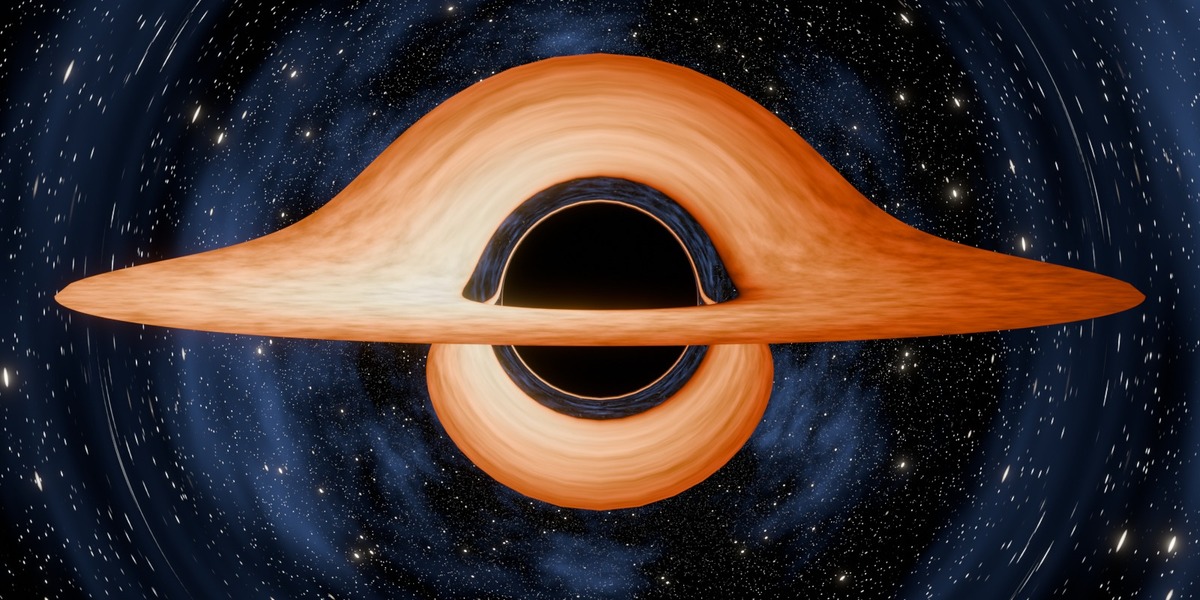
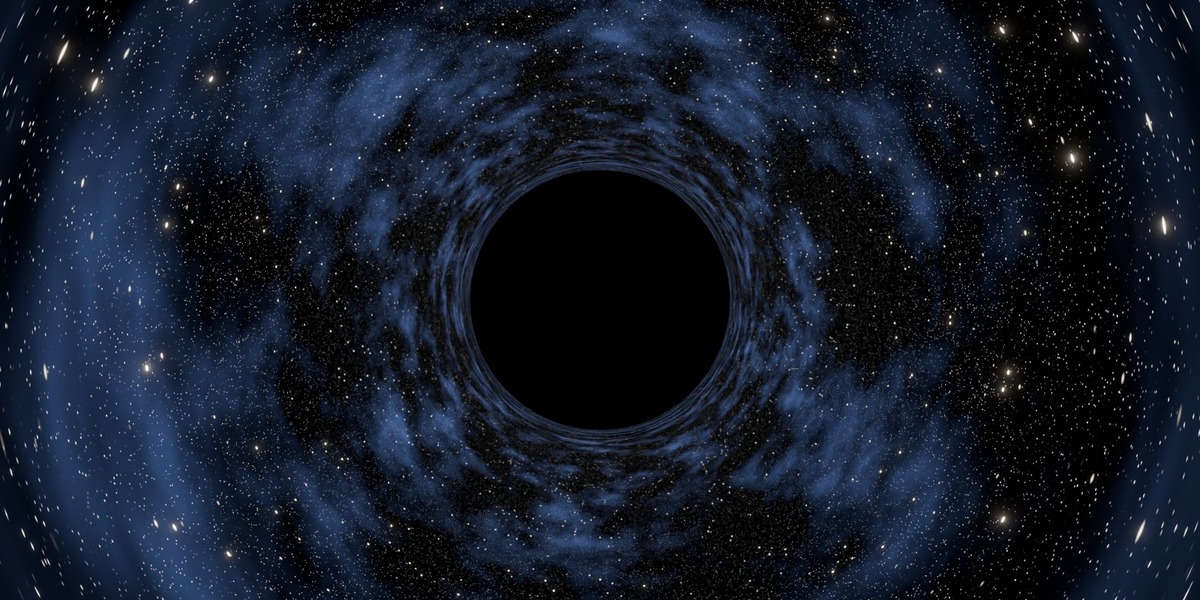
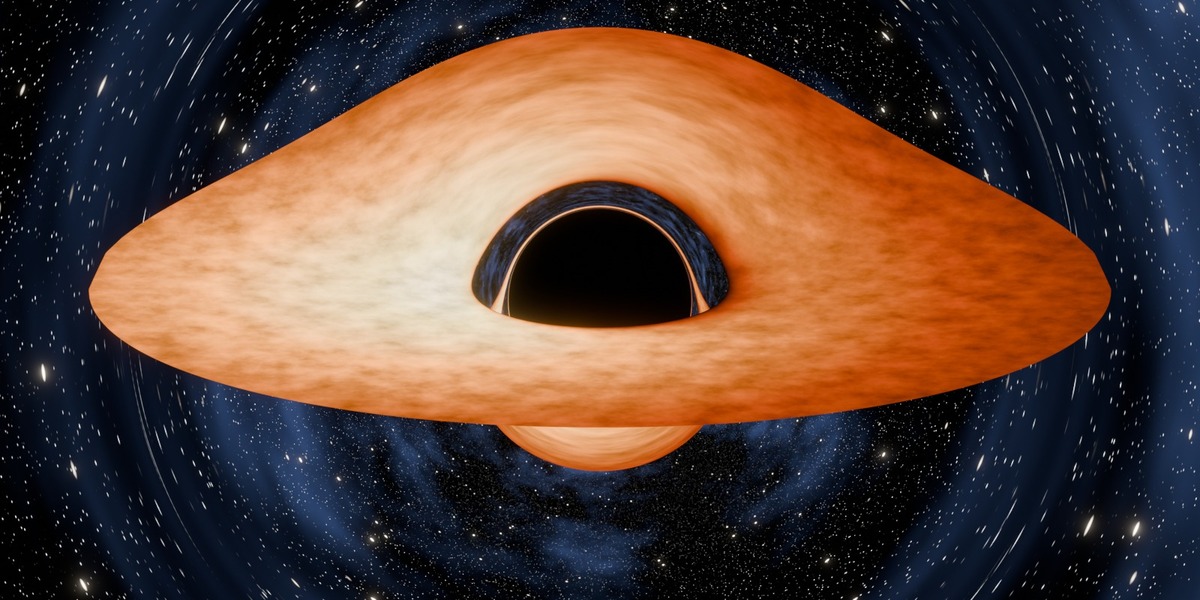
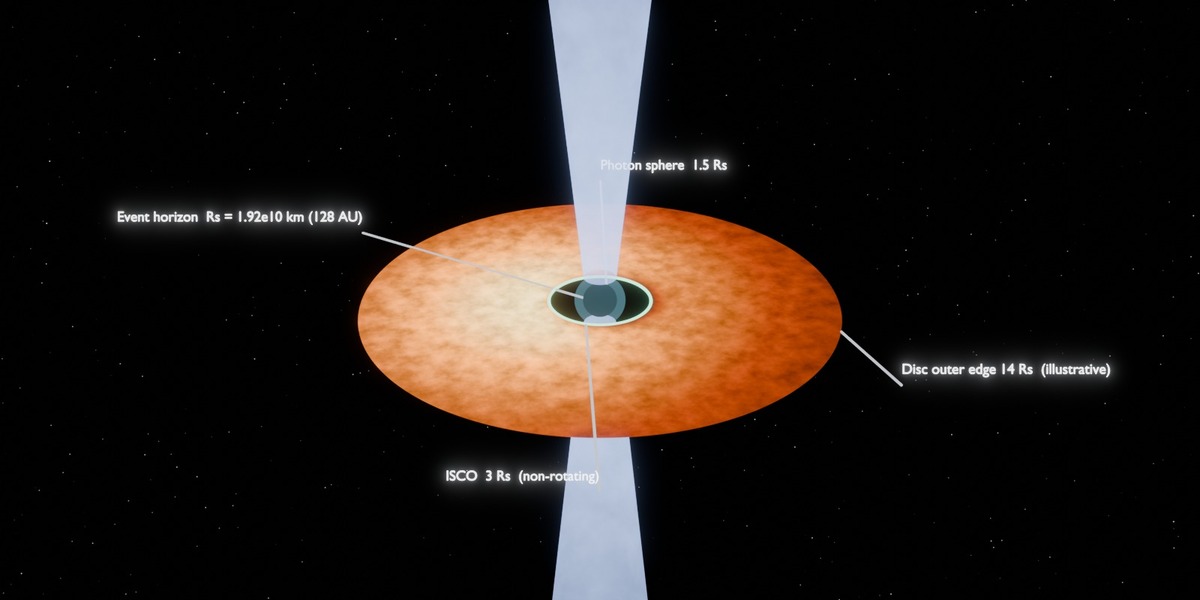
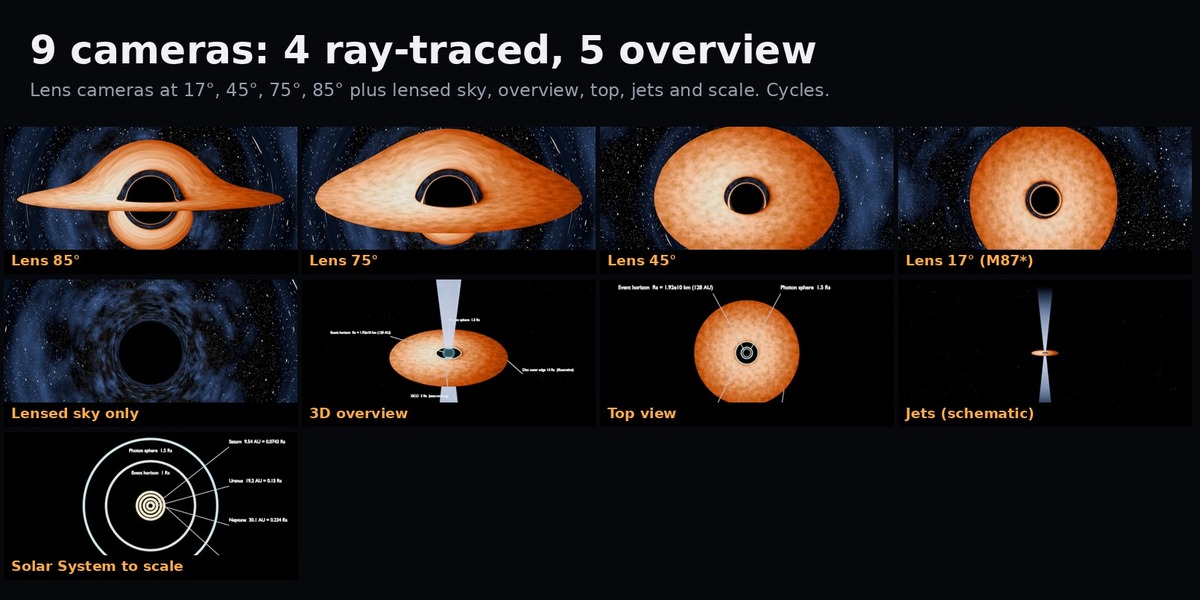
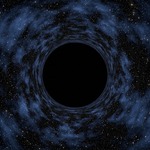
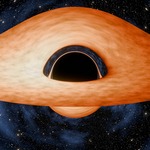
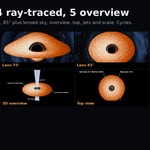
Not a glass sphere with a distortion shader: the script ray-traces the exact light paths around a non-rotating black hole in Python, so the picture is the one general relativity predicts.
What makes it different
- Real light paths. Primary and secondary (ghost) images of the accretion disc, plus the higher-order images that form the photon ring.
- Real physics in the colours. Doppler beaming and gravitational redshift are computed point by point: the approaching side is brighter and bluer.
- Real objects. M87*, Sgr A* and Cygnus X-1 with their measured mass and distance (EHT, GRAVITY, Miller-Jones 2021), or your own mass.
- Checked against observation. The predicted shadow of M87* is 39.7 microarcseconds; the EHT measured 42 ± 3.
What's included
- A ready-to-render .blend (Cycles) with the script embedded, plus the script itself so you can switch target, inclination or colours and rebuild.
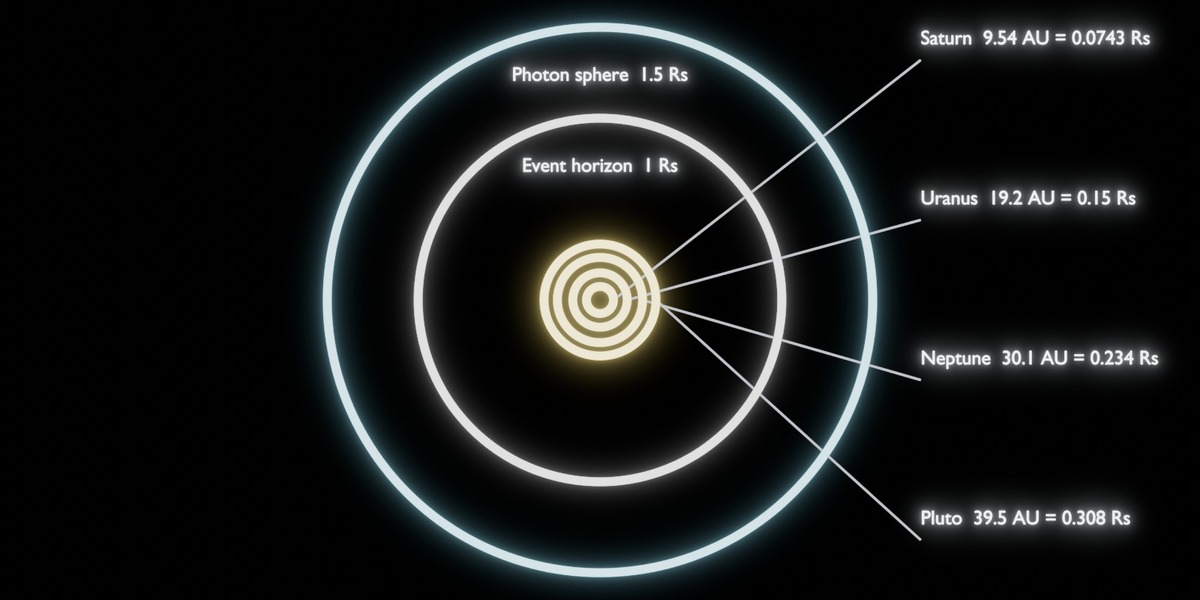
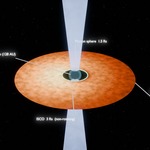
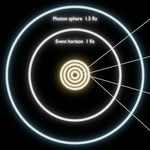
- 9 cameras: four ray-traced inclinations (17°, 45°, 75°, 85°), a lensing-only sky view, and 3D overview, top, jets and scale views.
- Stored on the objects: Schwarzschild radius, photon sphere, shadow, ISCO, ISCO orbital period and the predicted angular size of the shadow.
- The Solar System's planet orbits drawn to scale around the hole: everything out to Pluto fits inside the event horizon of M87*.
- Animated plasma turbulence, orange false colour (EHT style) or blackbody colours, glare in the compositor.
- README with what is real and what is not, CREDITS with all references.
What is illustrative (we say it up front)
- The black hole does not spin (Schwarzschild). Real ones do, which shifts the shadow and the ISCO slightly.
- The disc is a textbook thin disc for show: M87* and Sgr A* actually accrete hot, thick flows seen as synchrotron emission. Disc size, temperature and colours are illustrative.
- The stars and the faint nebula are random; their lensing is real. Jets are schematic and appear only in the 3D overview cameras.
Who it is for: science communicators, teachers, planetarium and YouTube creators, and anyone who wants a black hole that follows the physics.
Data: Event Horizon Telescope Collaboration 2019 and 2022; GRAVITY Collaboration; Miller-Jones et al. 2021; Luminet 1979; Shakura & Sunyaev 1973. Not affiliated with or endorsed by the EHT Collaboration, ESO or NASA.