 smice
smice


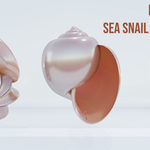
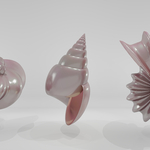
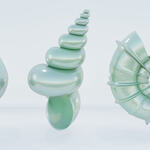
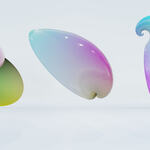
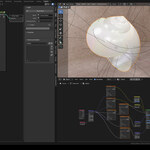
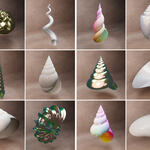
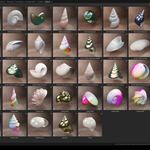
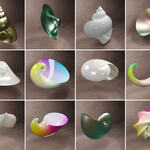
Creating snails and mussels in Blender Geometry Nodes based on the mathematical models of M. B. Cortie, J. Picado, and B. Frassek is powerful because it turns biology into a fully controllable design system.
Instead of sculpting a single static shell, a procedural setup lets you generate entire families of natural forms from a few adjustable parameters — growth rate, curvature, expansion, ribbing, thickness. With one node network, you can create endless variations that remain mathematically consistent and biologically believable.
From a creative and production perspective, this means:
-
Infinite variation without rebuilding models
-
Non-destructive workflow — everything stays editable
-
Scientific authenticity combined with artistic freedom
-
Scalable detail for animation, visualization, or generative design
-
Efficient asset creation for large scenes or collections
In short, procedural modeling transforms shell creation from manual modeling into a smart, parametric growth system — mirroring how nature itself builds these forms.
Background: In 1993, M. B. Cortie developed mathematical formulas to explain how the beautiful spiral shapes of sea snail shells form. Instead of looking at the shell as something static, he described it as a shape that grows step by step. His model showed that as the snail grows, its shell expands in a regular, repeating spiral pattern — and that small changes in growth speed or direction can create very different shell shapes.
Later, in 2009, J. Picado built on similar ideas by refining the mathematical descriptions of shell growth. He focused on how simple growth rules can generate the wide variety of shell forms we see in nature. In essence, both researchers used mathematics to show that complex, beautiful shell shapes can arise from surprisingly simple growth processes over time.
B. Frassek also developed a mathematical model to describe how sea snail shells take their shape as they grow. Instead of focusing only on the spiral form itself, his work looked more closely at how changes in growth rate, shell thickness, and curvature influence the final appearance of the shell.
In simple terms, he showed that if you slightly adjust how fast different parts of the shell grow, you can reproduce many of the shapes found in real sea snails — from tightly coiled shells to more elongated or flared forms. His model helped demonstrate that the incredible diversity of shell shapes in nature can be explained by small variations in a few basic growth rules.