 TastyVoxels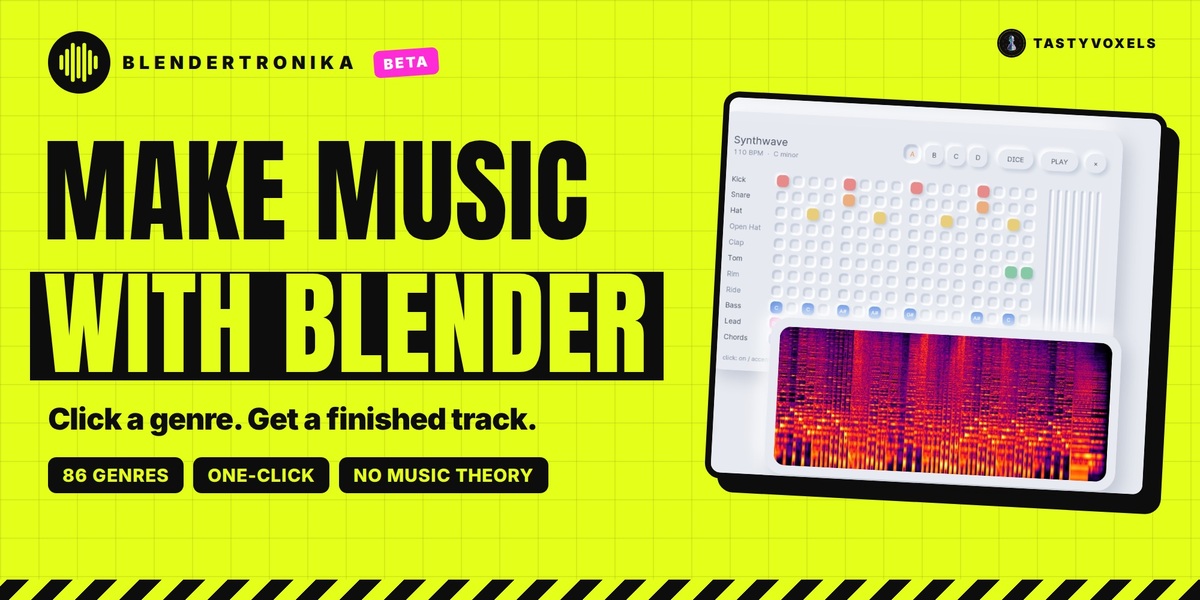

Beta: complete, and shaped by you
Blendertronika is in beta. Everything on this page is in the add-on and works today, and it is checked by automated tests before every release (the numbers are at the end). The beta is my way of saying that I want to hear from you: what you made, what felt hard, what you wish it did. Every piece of feedback helps, and you can send it through the Superhive inbox. Thank you.
Pick it. Shape it. Put it in your scene. Your animation needs music, and you are not a musician. Blendertronika is a music maker that lives in Blender's sidebar: click a genre and it plays, click a few buttons with plain names and it becomes your track, press Add Music To This Scene and a finished song, as long as your scene and ending on your last frame, is in your scene: press Space and you hear it. Then let your objects move to the kick.
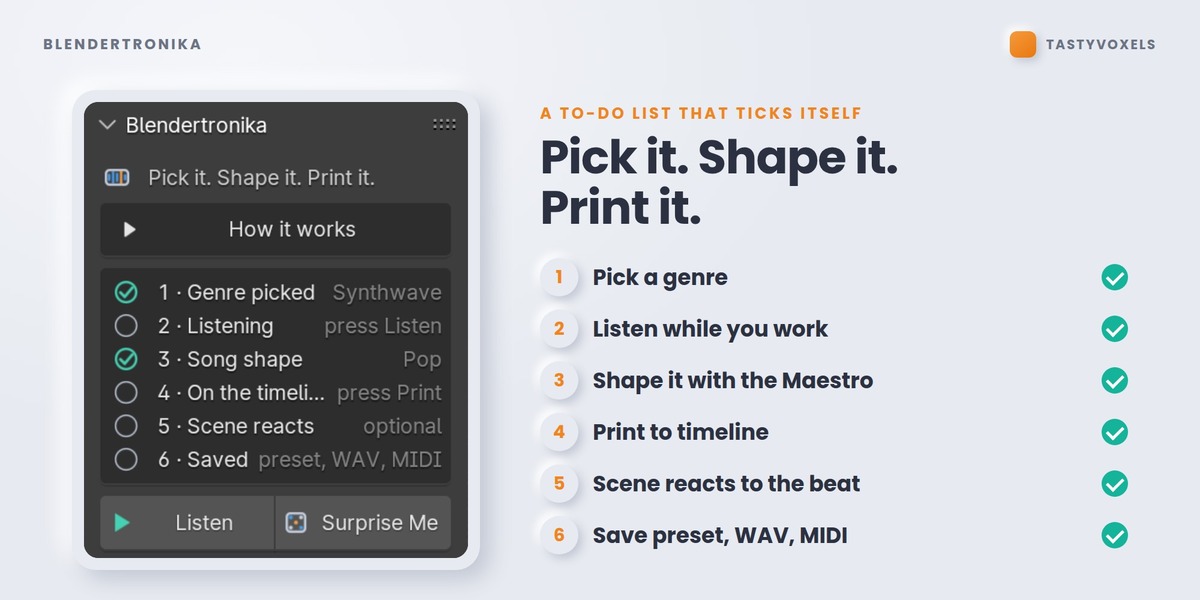
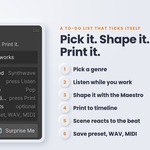
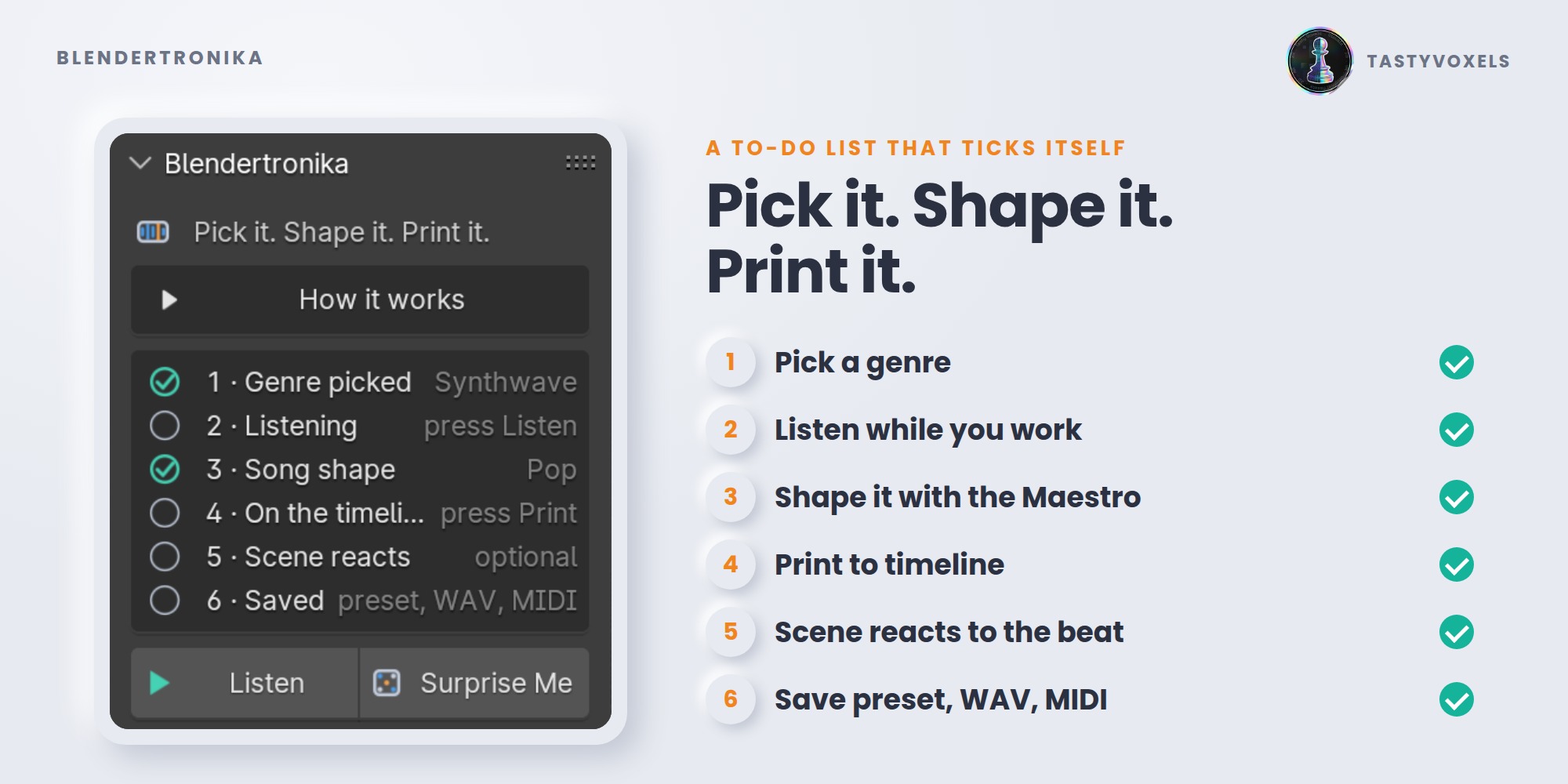
Seven steps, numbered in the panel
The panel is a to-do list that ticks itself. At any moment you can see where you are and which button comes next.
- Pick a genre. Music starts on the first click. Click the same genre again and you get a different take on it: new bass line, new melody, same style.
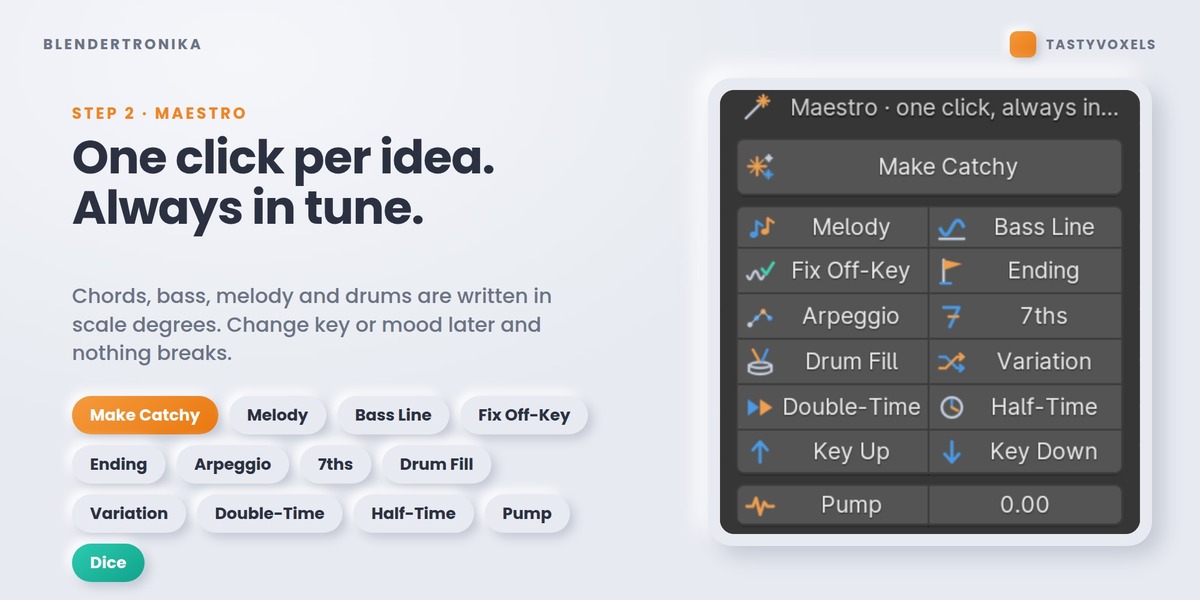
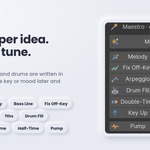
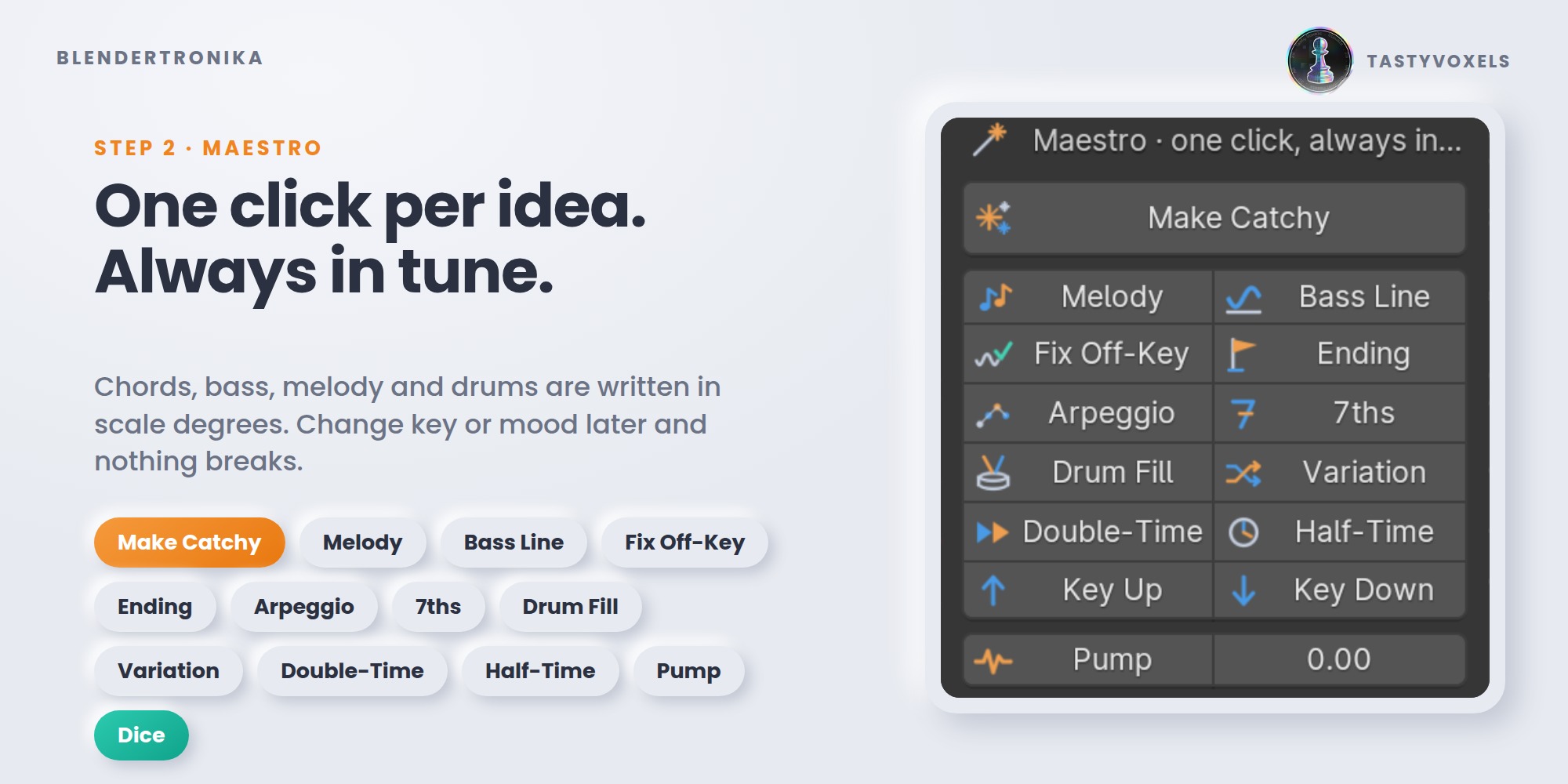
- Shape it. Tempo, key, mood. The Maestro buttons do the musician's work: Make Catchy, Melody, Bass Line, Fix Off-Key, Ending, Arpeggio, 7ths, Drum Fill, Variation, Double-Time, Half-Time, Pump, famous chord progressions and ready-made drum grooves. Everything is written in scale degrees, so it is always in tune - change key or mood later and nothing breaks.
- Make it a song. Song templates tell your pattern as a story: intro, verse, chorus, break, build, outro, stretched over your whole scene. Transitions sweeps a riser into every lift and a sweep-down out of every drop-out, so each change of part has a reason.
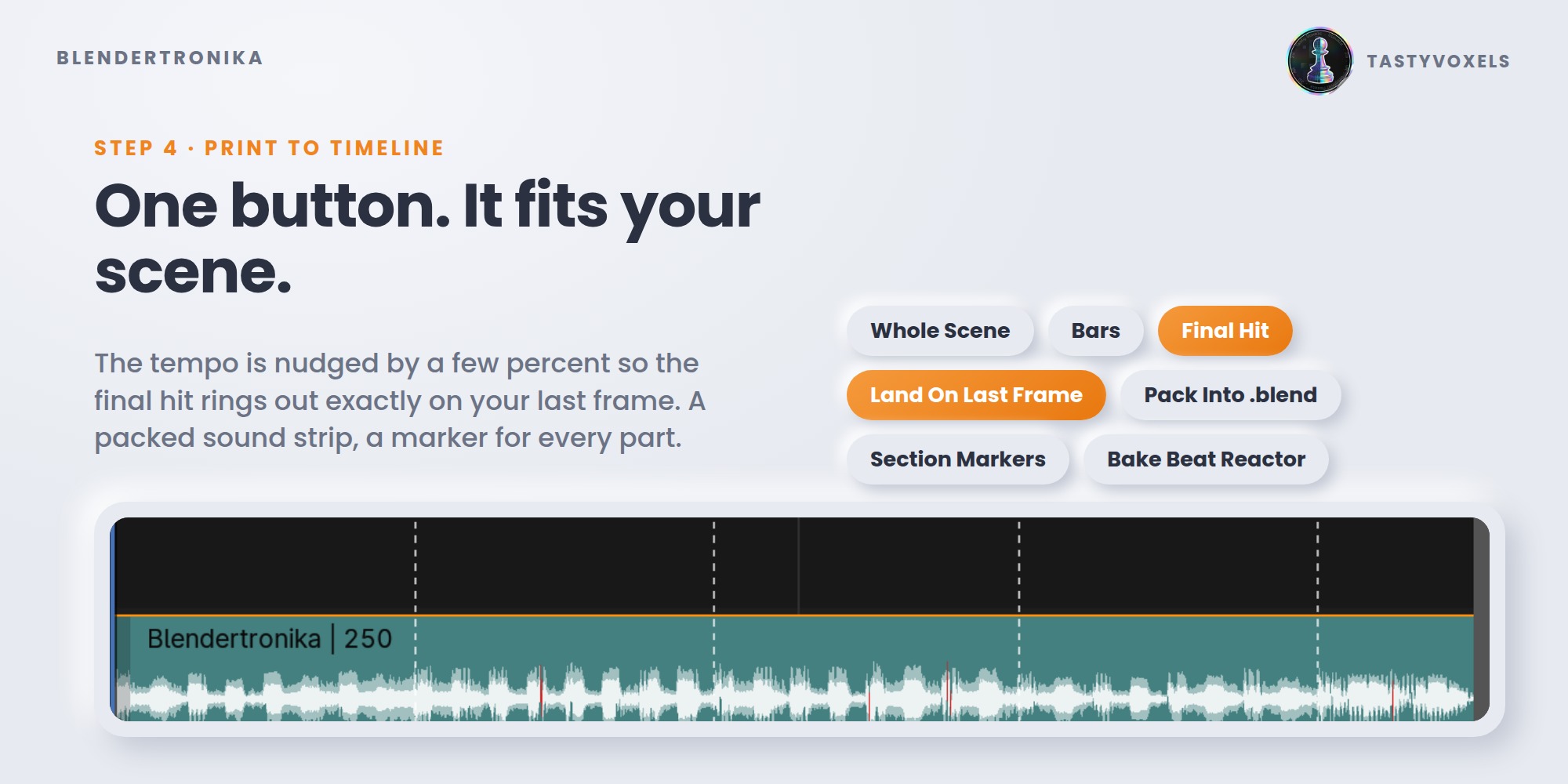
- Put it in your scene. One button, Add Music To This Scene. The tempo is nudged by a few percent so the final chord rings out exactly on your last frame. The song lands in the Video Sequencer, packed inside the .blend, with its waveform showing: press Space and you hear it with your animation, and it is already part of your edit and your render. Music Hits: mark a frame and the music lands on it.
- Beat Reactor. Objects follow the kick, the bass, the melody.
- Take it out. The finished song as WAV, MP3, OGG or FLAC, a seamless loop for game engines, stems and MIDI for other music programs, and MIDI in, to bring a clip from your DAW into a pattern. Your own presets and packs too.
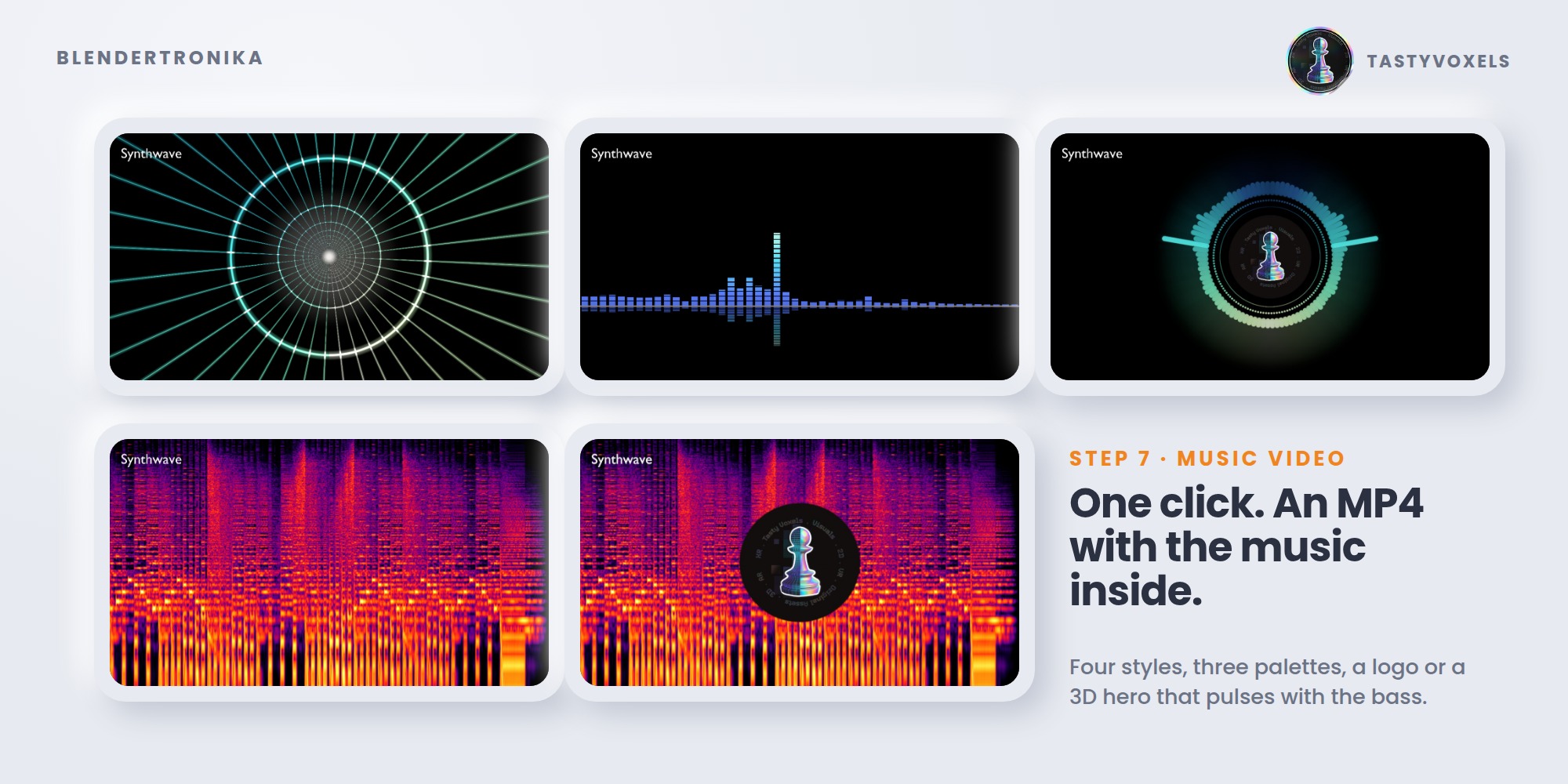
- Music video. One click, one MP4 with your music inside, in five styles. One of them is the Studio itself.
Blendertronika is Rego Beat for Blender
Rego Beat is the music maker I wrote for my own project, Regolith Highfield. Blendertronika is that engine adapted for Blender and living in its sidebar, so the music is made where the animation is made. The wider Regolith tools may one day also exist outside Blender - as a separate app, installable or in the browser - but if and how I share them is my decision, and nothing in this add-on depends on it. What is on sale here is this add-on: complete, offline, and finished today.
The timeline is the arranger
This is the part made for Blender people. Energy, Pattern, Fill and every Mute switch are ordinary animatable properties. Hover, press I, move the keyframe to the cut. As Energy falls, the ornaments leave, then the snare, the melody, the bass; as it rises they come back. Your music follows your edit, bar by bar, instead of the other way round. Not in the mood? Template To Keyframes writes a whole song as keyframes for you to push around.
Music Hits: the music lands on your moments
A character lands, a logo appears, the cut changes. Put a timeline marker named Hit on that frame (or press Add A Hit Here) and the music plays to it: a build-up that rises for two bars and arrives exactly on the frame, an impact on it (Impact, Boom or Crash), and the rest of the music ducking under it for a moment so the hit stands out. If you like, a breath of silence just before. The Beat Reactor curves get the hit too, so objects that follow the kick jump on that very frame. Add as many hits as your scene has moments; seamless game loops never carry them.
Beat Reactor: audio-reactive without the baking ritual
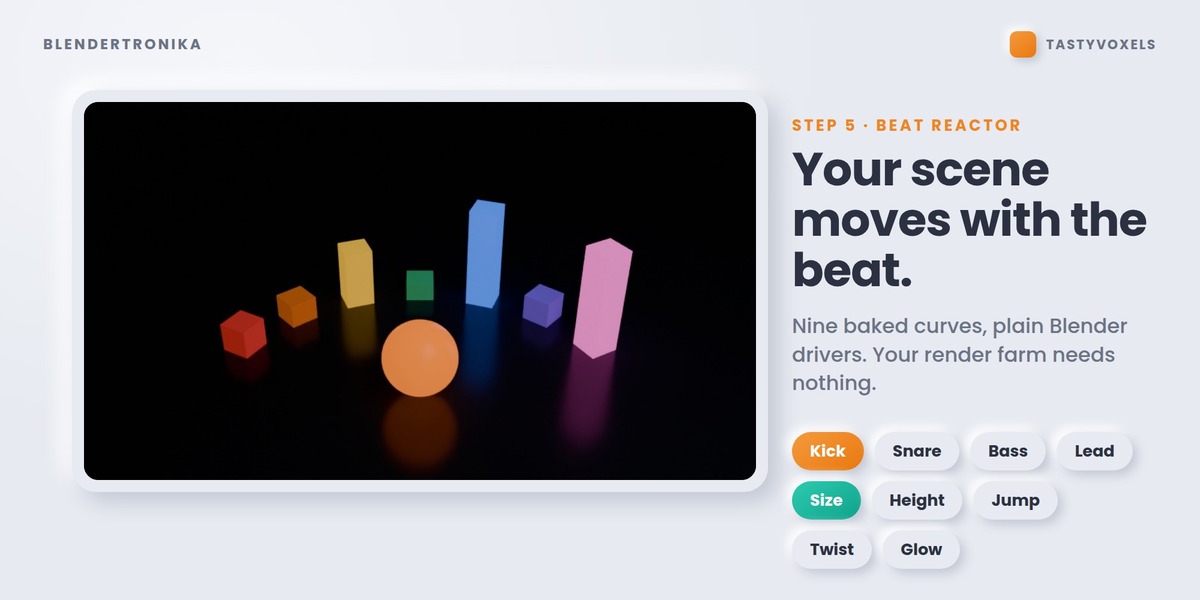
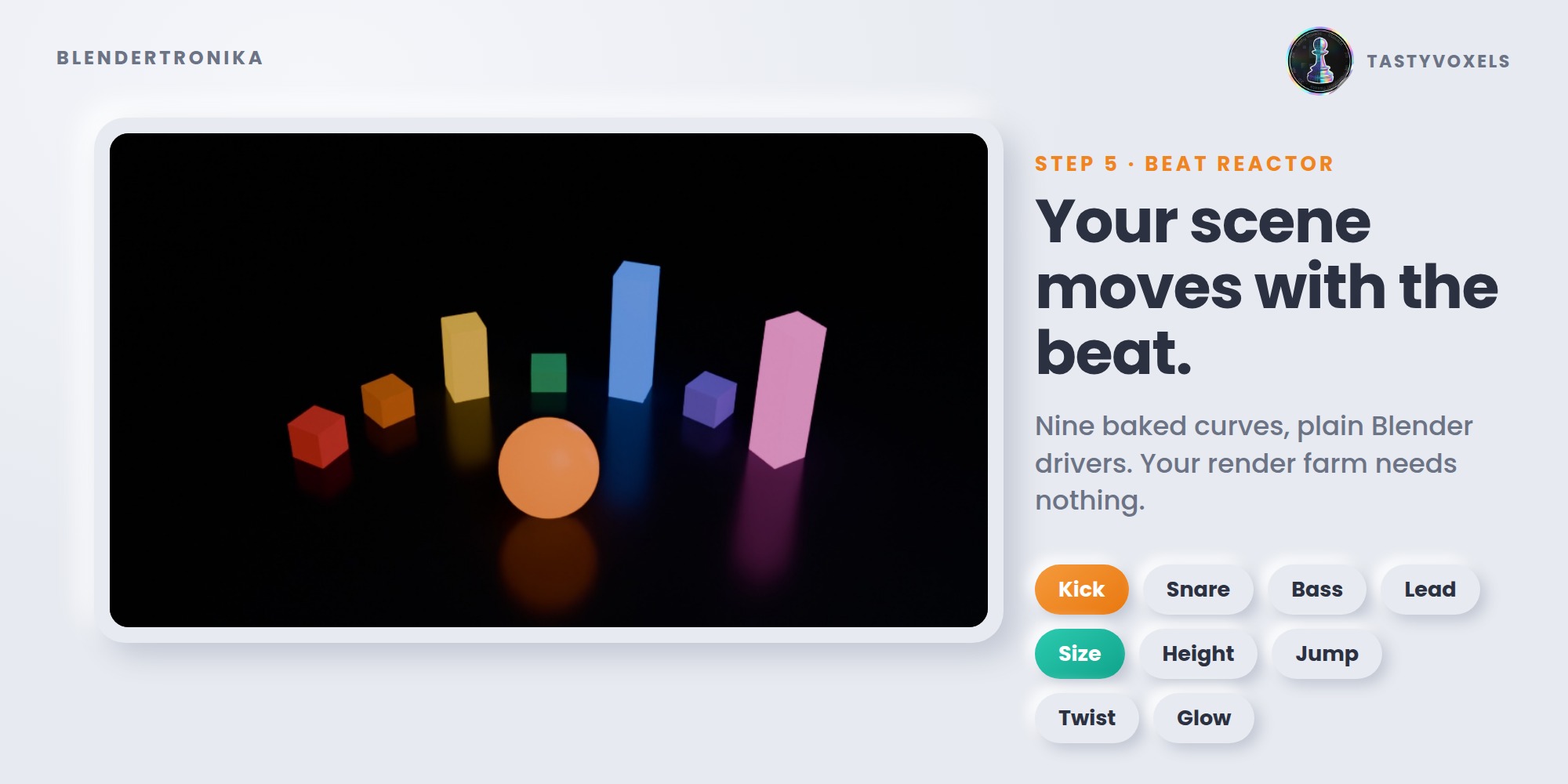
Printing the music also writes nine clean 0-1 curves on the scene: kick, snare, hats, perc, bass, chords, lead, everything, beat. They come from the instruments themselves, not from guessing at a mixed waveform, so the kick curve is only the kick. Select objects, choose what to follow and what to move (size, height, jump, twist, glow), click Make Selected React. It is a plain Blender driver: it renders on any machine and any farm, with or without the add-on. Add Visualizer builds a small stage so you see it work in ten seconds.
Reactive Groups: every set of objects moves its own way
Make a group from the selected objects and give it its own Size, Jump, Turn, Spin and Glow, each following the instrument you choose: the drums grow on the kick, the lights glow on the bass, the logo spins once every four bars. Changes show while you drag, glow is per object even on shared materials, and leaving a group puts an object back in its own pose. Plain drivers: they render anywhere.
Viewport Preview: a groovebox in your viewport
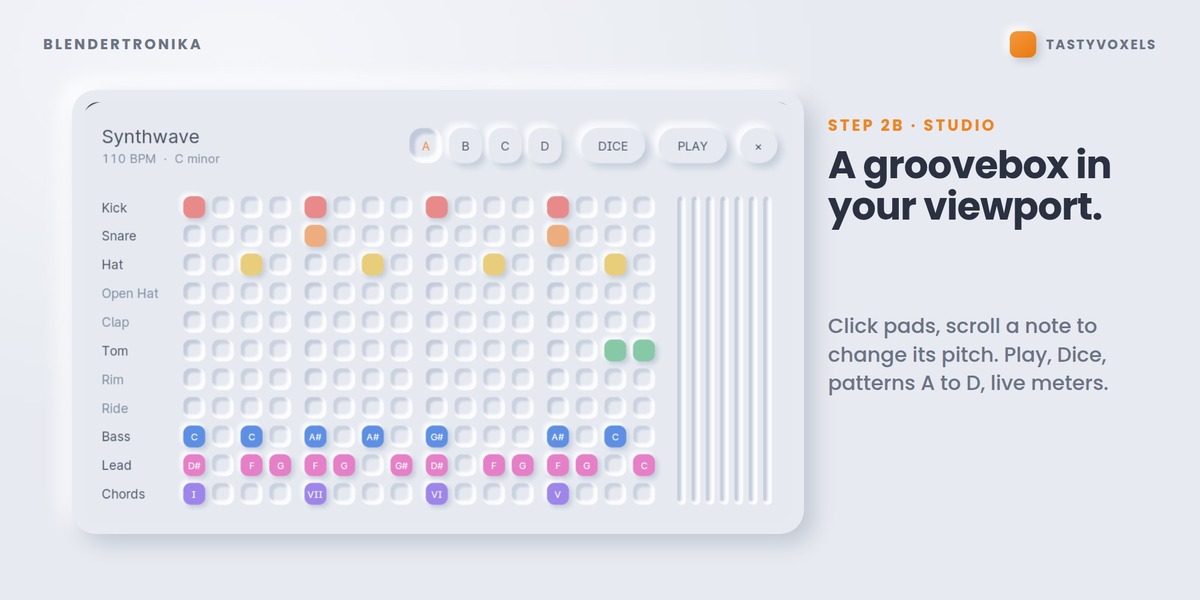
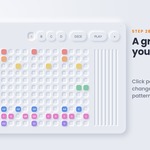
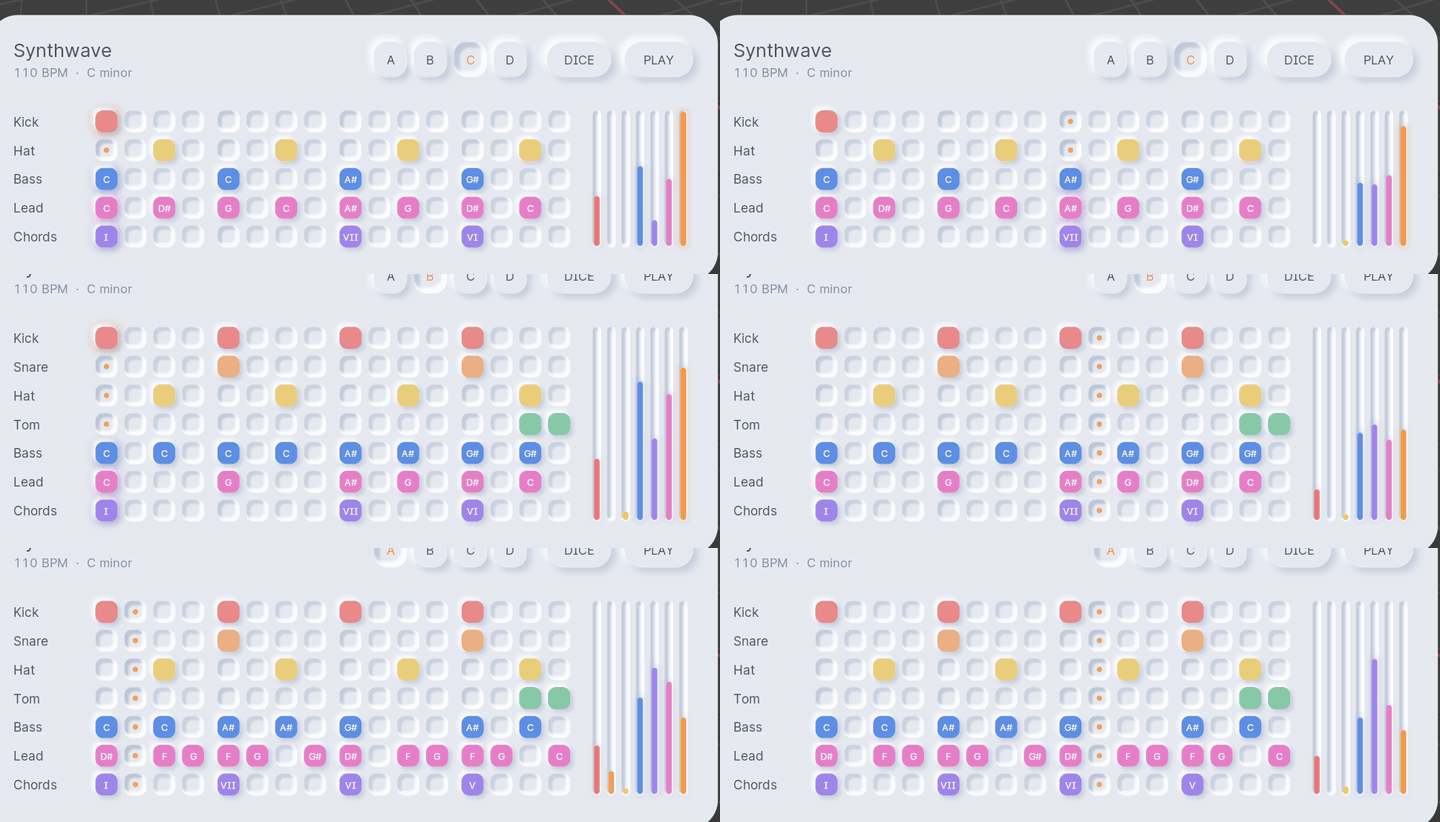
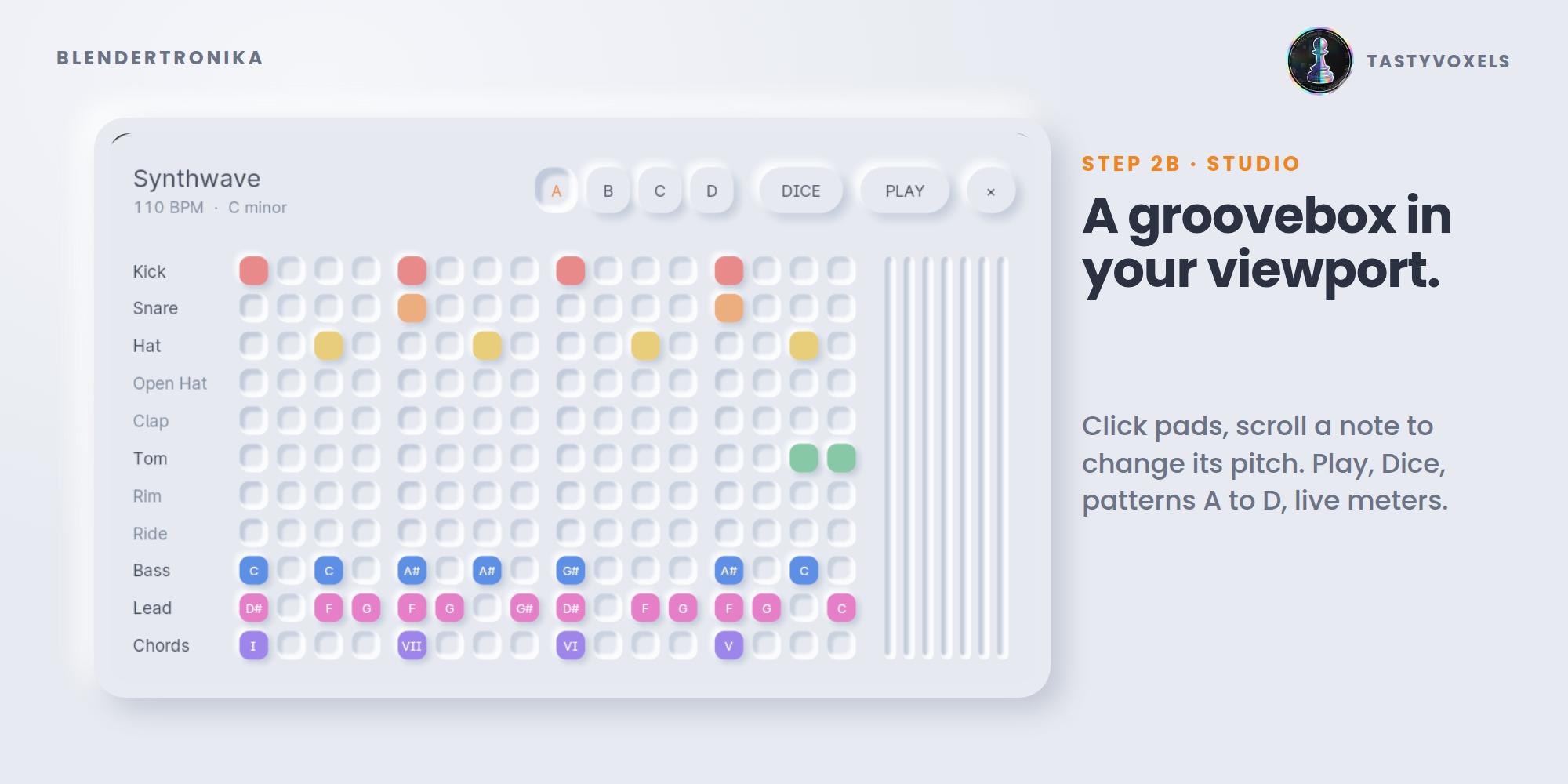
Viewport Preview draws a soft, neumorphic instrument right over the 3D view: raised pads, pressed wells, a glow on whatever is playing, live meters. Click a pad to switch it on, click again for an accent, scroll on a note to change its pitch, press Play, Dice, A-D. It is drawn by one small GPU shader, it follows Blender's interface scale, and Esc gives the viewport back.
Music Video: from track to MP4 in one click
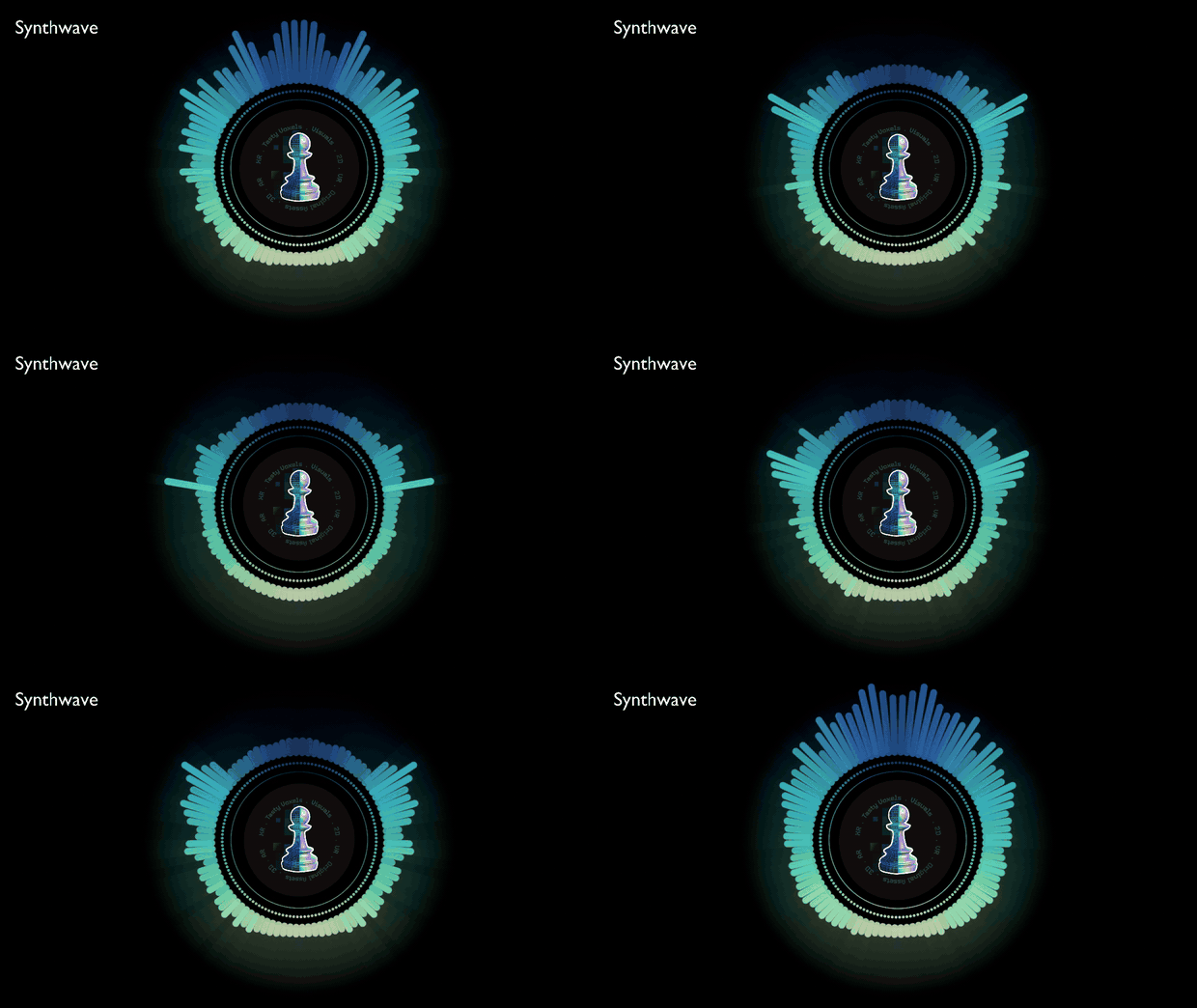
Made a track you like? Render Music Video gives you an MP4 (H.264 picture, AAC sound), landscape, vertical or square. Two complete videos: Pulse Ring, a circular spectrum that breathes with the kick, with your logo, an object or a whole collection turning in the middle; and Studio Pad, the Studio itself drawn frame by frame, in your colours, with your title, your depth colours and only the parts you want. The Pulse Ring also comes as Blenderpunk (black ink on acid yellow), Holo Glass and Holo Glass Dark (rainbow glass). Preview Music Video shows it in the viewport before anything is rendered.
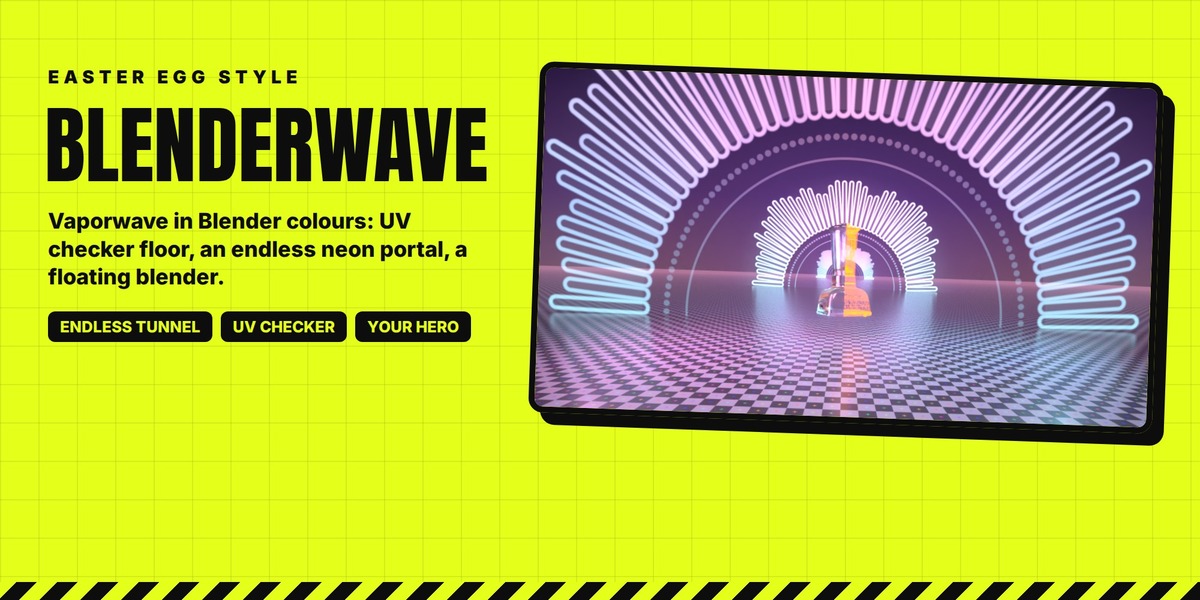
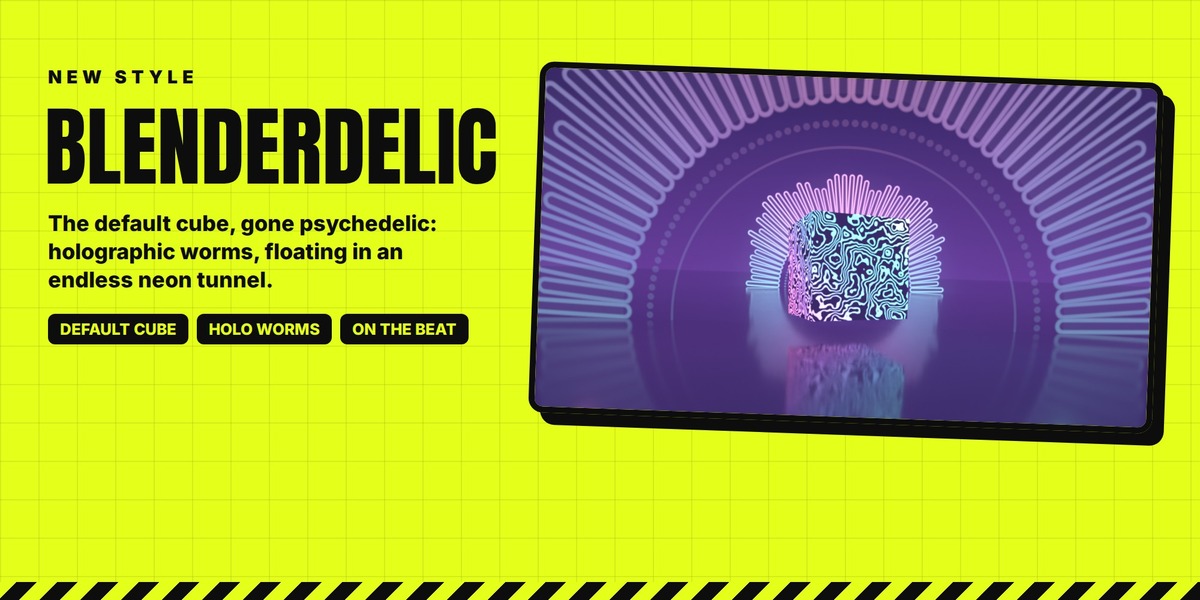
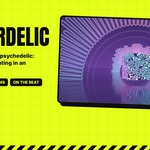
BlenderWave is a real 3D stage in vaporwave, in Blender's own spirit: the UV checker as floor and wall, a half-sun neon portal repeating as an endless tunnel that fades in the fog, and, if you do not pick a hero, a certain kitchen appliance floating in the middle, half holographic glass, half Blender-orange wireframe. Floor, background, sun and tunnel speed, spacing and number of portals can all be changed. Blenderdelic puts Blender's default cube, black with holographic worms (or in see-through holographic glass), on a dark mirror inside the same endless portal tunnel. Both stages can take Neon Bars or the Oscilloscope as their sky, reflected by the floor.
It is Blender, so the visual can also live in your scene: In My Scene puts it behind your own camera and you keep animating while it plays, rendered with your engine and your settings. Put The Visual On Selected makes any style a material on your objects: a TV screen, a floor, a sign. Oscilloscope, Neon Bars, Lava Spectrum and Neon Wormhole are backgrounds: behind your scene, as the sky of a stage, or on the screens of your own radios and monitors; point the add-on preferences to a folder of your own models and their screens play the music while their bodies wear the song. Material presets (glass, frosted and wavy glass, chrome, gold, holographic, neon, Blenderpunk, holographic worms, stripes and crosses) dress your objects in one click; glass looks are at their best in Cycles, and in Eevee you can give any group your own glass.
For people who do know music
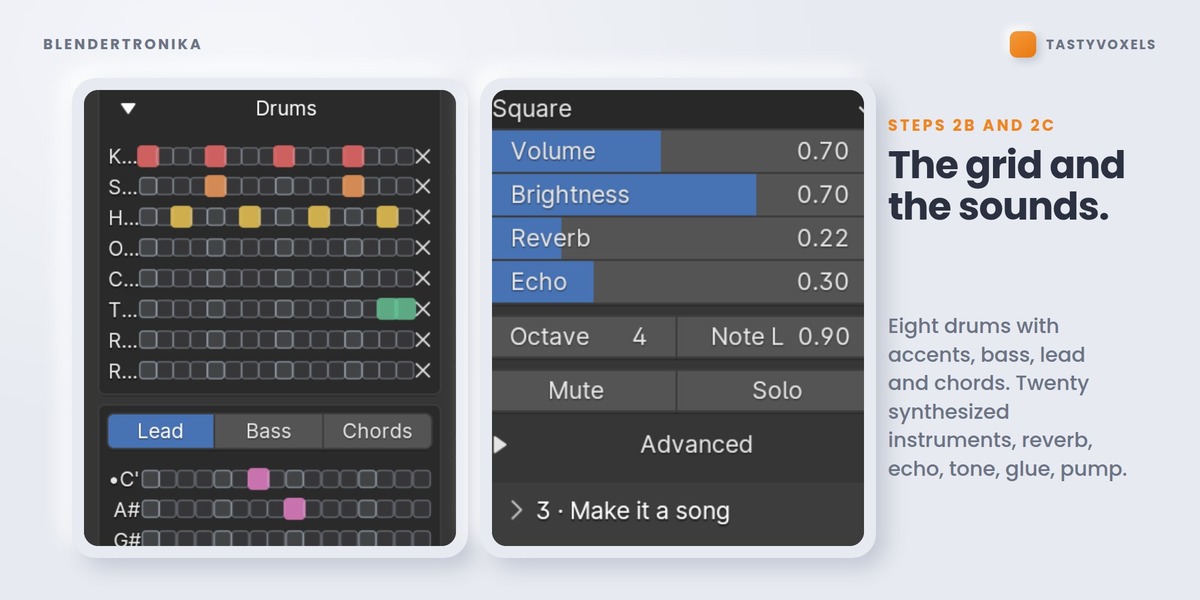
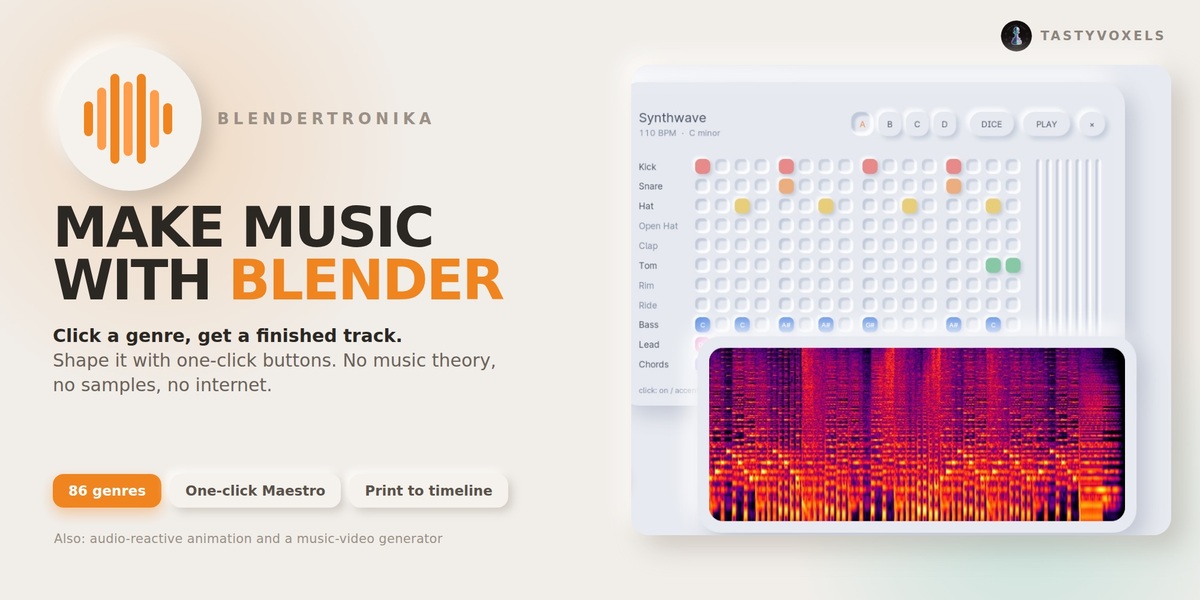
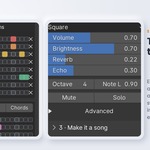
A real step grid: eight drums with accents, bass, lead and chord rows labelled with the notes of your key. Twenty synthesized instruments - saw, square, supersaw, piano, e-piano, strings, choir, guitar, nylon, harp, marimba, kalimba, music box, bells, organ - and eight synthesized drums, each with its own controls. Reverb, tempo-synced echo, master tone, EQ, glue compression, sidechain pump. A live loop that re-renders while you click, so you hear every change.
My Voices: go as deep as you like
Every built-in sound is synthesized, but you are not limited to them. Give any part or any drum a voice of your own: a recording of your instrument (a WAV, played at every pitch, in tune), or a voice written in Python, one function that returns the sound as a numpy array, with a documented template to start from.
Python can do anything your user account can do, so Blendertronika never runs a Python voice until you have read it and pressed Trust, and that trust belongs to the exact file: change one character and it is switched off until you trust it again. Voices that come in a pack from someone else always arrive switched off. This is informed consent, not a sandbox: trust only code you have read or whose author you trust.
Your presets are yours - and they are files
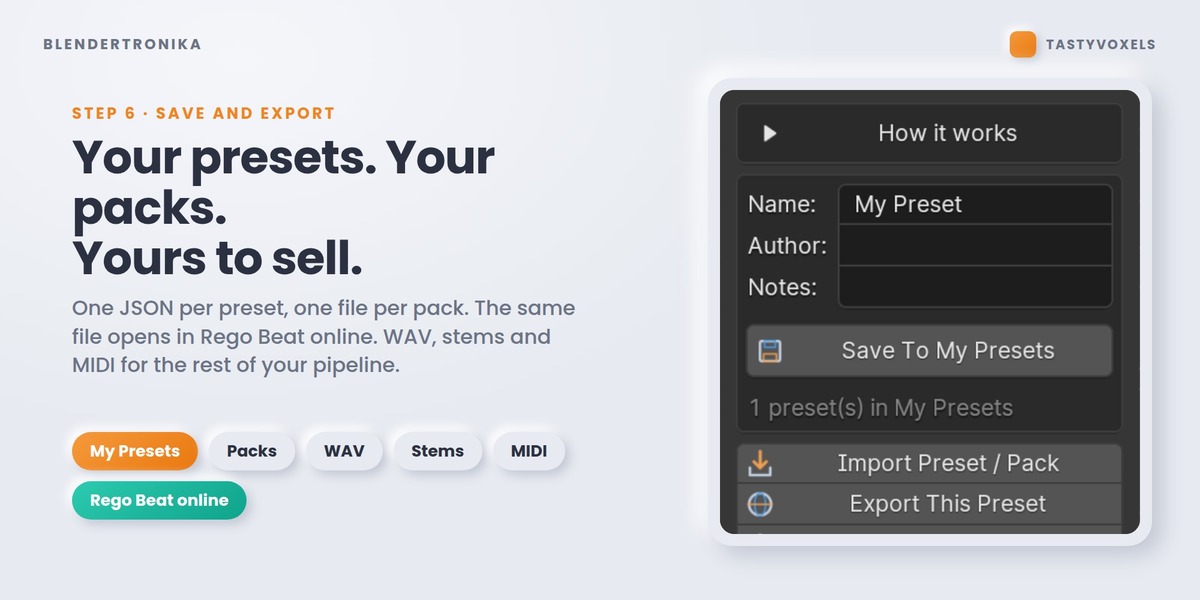
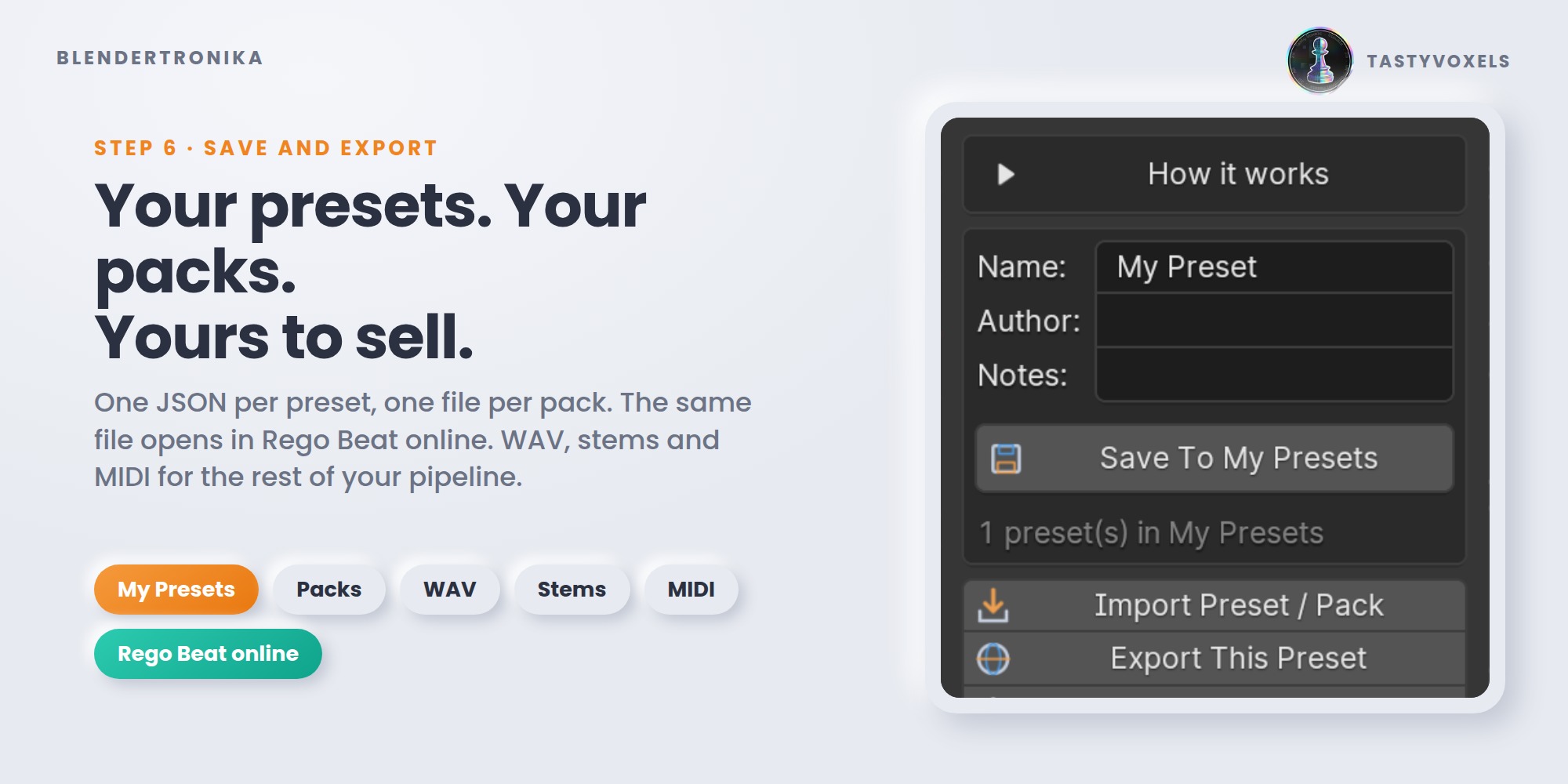
Save To My Presets keeps the whole song: four patterns, every sound, the mix. Export My Presets As Pack writes all of them into one file you can share, sell, or load in your own tools - the format is open and documented inside the add-on. Export Pack With My Voices puts them in one .zip together with the recordings and Python voices they use, so a pack made with your own instruments travels whole. And because a preset is also a valid Rego Beat online project, the same idea travels between Blender and the browser.
What it is not
It is not a DAW, it does not record audio and it does not host VST plugins. Every built-in sound is made by the add-on's own synthesizers at render time, which is why there is nothing to download and nothing to license; the only recordings inside a song are the ones you choose to add. The music you make is yours.
Requirements
Blender 4.3 to 5.2. Windows, macOS, Linux. Uses only what ships with Blender (Python, numpy and Blender's own audio library, which also encodes the MP3, OGG and FLAC files). No internet, no external programs, no dependencies to install.
NO AI INSIDE THE PRODUCT
No model, no inference, no telemetry, no network access, no data collection. The Maestro is music theory written as code - scale degrees, chord tones, cadences - and the instruments are plain synthesis maths. It runs offline and gives the same result from the same seed, forever.
AI assists me while I work: it writes code with me, and it translates my documentation into English, which is not my first language. I have been programming since long before generative tools were mainstream; the engine here is the same one that runs Rego Beat in the browser. The numbers: 216 automated checks pass on Blender 4.3, on Blender 4.5 LTS and on Blender 5.0 before this release, a quick run inside Blender 5.2 LTS makes a song, writes all four audio formats and draws the Studio on the graphics card, and every one of the 86 genres is rendered and measured for level and clipping each time.
Covers, shirts and posters
The whole song as one picture: a spectrogram, a ring like a record or a wave, in Lava, Neon, Aurora, Blenderpunk or one ink for screen printing, at album cover, T-shirt, poster or banner size, with a transparent background if you like.
Support
Updates and support are included for good - no support period, no renewal fee. Questions and feedback: Superhive inbox. There is a Feedback panel in the add-on too: tell me what to add, what to improve, what to explain better. More genres and more Maestro tools are on the way.
Tasty Voxels x Regolith Highfield - GPL-3.0-or-later