 3D Tudor


Hay Shader Pack
Build bales, loose piles, fitted wagon loads, ground scatter and multiple thatched-roof styles from one editable Geometry Nodes and PBR system.
23Core prototype objects
|
11PBR texture sets
|
62Standalone PNG maps
|
5.1+Verified in 5.2 LTS
|
One consistent hay system for props, ground and architecture
The 3D Tudor Hay Shader Pack combines PBR textures, alpha-card clusters, trim sheets, editable support meshes and a flexible Scatter on Surface Geometry Nodes workflow.
It is a reusable production toolkit rather than one fixed shader or finished bale, helping you carry the same visual language from small props to a complete rural environment.
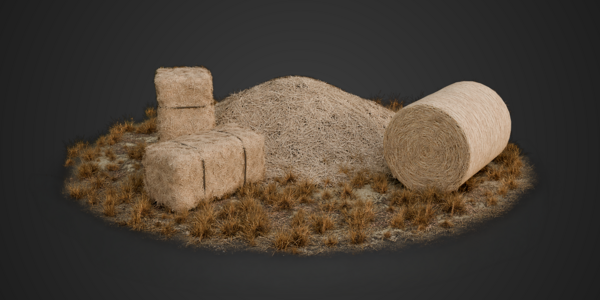
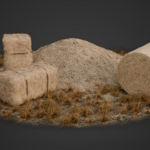
The prop set combines rectangular bales, a rolled bale and a reshapeable loose pile with scattered cards that soften silhouettes and add visible straw breakup.
Shape-adaptable procedural workflow
Choose the closest starting form, edit or scale its support mesh, then tune density, distribution, spacing, masks, alignment, offset, scale, rotation, randomisation, seeds and viewport visibility.
Keep instances procedural during look development. Realise and convert them only when a downstream export workflow requires actual mesh geometry.
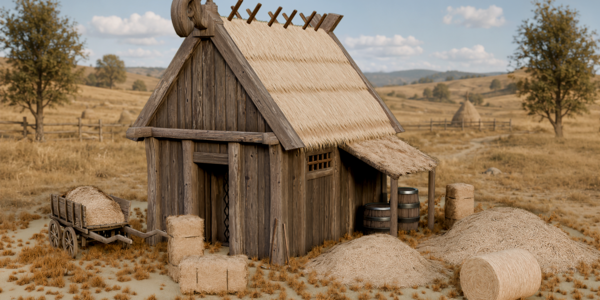
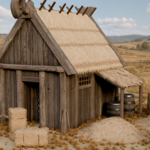
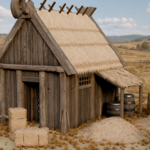
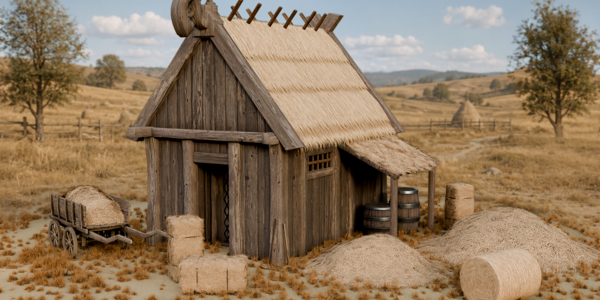
A finished rural composition brings the roof, ground dressing, bales, loose piles and fitted cart-load use cases together in one consistent visual system.
What is included
- 1 Blender project file and 23 core prototype objects
- Rectangular bale with separate rope geometry, 2 rolled-bale variations and a reshapeable loose pile
- 2 hay ground surfaces, 2 loose-straw decals, 4 flyaway cards and 4 dry vegetation cards
- 2 long directional trims and 4 smaller organic trim pieces
- 2 core roof-surface approaches and 3 presented thatched-roof looks
- 3 prepared example compositions and a dedicated roof comparison collection
- 11 PBR texture sets comprising 62 standalone PNG maps
- 45 maps at 2048 x 2048 and 17 maps at 1024 x 1024
- All height and normal maps supplied at 2048 x 2048 in 16-bit format
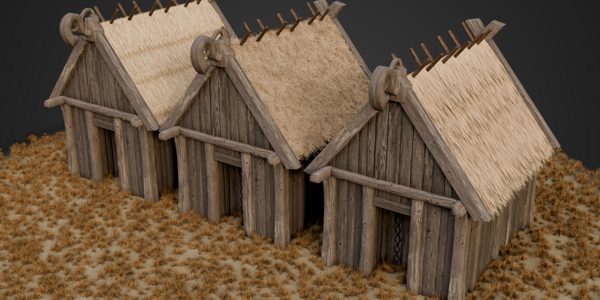
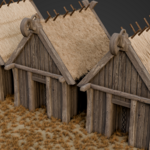
Three roof presentations demonstrate loose organic straw, layered directional courses and long directional thatch built from the same modular system.
Performance-aware construction
Low-complexity support forms, textured plane clusters, decals and trim cards create visible strand breakup and softer silhouettes without modelling every straw separately. Final evaluated geometry depends on the selected source assets, density settings and whether instances are realised.
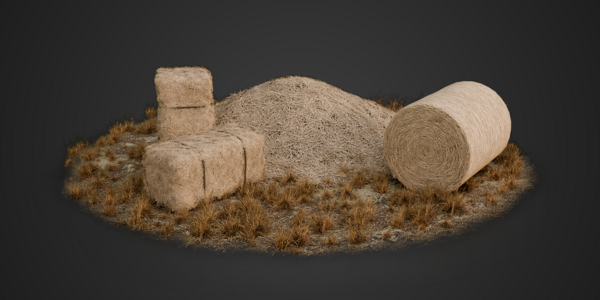
A second prop view highlights the shared PBR response and scattered surface breakup across stacked bales, a rolled bale and loose hay.
Documentation & Quick Start
The package includes the Blender project and standalone texture maps. Use this quick-start guide as the recommended non-destructive workflow:
- Choose a starting asset. Begin with the closest ground, decal, bale, rolled bale, pile, trim or roof setup.
- Shape the support mesh. Edit or scale the low-complexity base form to match the required silhouette, surface or container.
- Tune Scatter on Surface. Adjust the source object or collection, density or amount, minimum distance, seed and distribution mask.
- Art-direct the breakup. Refine alignment, surface offset, scale, rotation and randomisation while keeping the setup procedural.
- Prepare for export only when needed. Duplicate the finished asset, realise the required instances, apply or convert the result, then verify materials, alpha handling, normals, scale and evaluated geometry.
Recommended: Keep the original procedural version intact so you can return to it for later shape or density changes.
Compatibility and export
Created as a Blender 5.1-era project and verified in Blender 5.2 LTS, with materials prepared for Cycles. Earlier Blender versions have not been tested.
Example compositions are included; cameras and lighting are not. For engine export, duplicate the procedural asset, realise the required instances, apply or convert the result, and check materials, alpha handling, normals, scale and evaluated geometry for the destination.
Frequently Asked Questions
Is this only a shader?
No. It includes PBR materials and maps plus editable forms, alpha-card sources, trims, ground dressing, roof treatments and the Geometry Nodes scatter workflow.
What files are included?
One Blender project file plus 62 standalone PNG maps organised into 11 PBR texture sets.
Can the hay fit a custom shape?
Yes. Edit or scale the support mesh before tuning the scattered breakup. A prepared wagon composition demonstrates the workflow.
Are all maps 2K?
No. The package contains 45 maps at 2K and 17 at 1K. Every normal and height map is supplied at 2K in 16-bit format.
Which Blender version and renderer should I use?
The project is from the Blender 5.1 era and has been verified in Blender 5.2 LTS with Cycles. Earlier Blender versions have not been tested.
Are cameras and lighting included?
No. The example compositions are included, but camera and light datablocks are not.
How do I export to Unreal Engine, Unity or another destination?
Duplicate the procedural asset, realise the required instances, apply or convert the result, and check the destination material, alpha, normal, scale and geometry requirements. Target-specific optimisation remains the artist's responsibility.
Build the version your scene actually needs
Start with the nearest form, shape it to the environment, tune the breakup and keep it editable until you are ready to commit.
Happy modelling everyone!
Neil - 3D Tudor
Explore Similar 3D Tudor Shader Packs
More material libraries built for practical Blender scene work.

Join the 3D Tudor Community
For support, inspiration, updates, giveaways, feedback threads and community builds, join the 3D Tudor spaces below.