 Skava
Skava


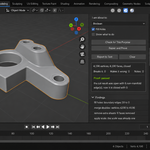
MeshProof — Documentation (v1.1.1)
Finds the geometry that breaks a particular operation, repairs it and proves the repair by running that operation again.
1. Install
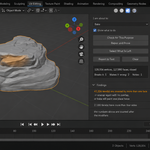
Download the zip and leave it zipped. In Blender open Edit, then Preferences, then Add-ons. Use the arrow button in the top right corner of that window and choose Install from Disk, then pick the zip. Tick the checkbox next to the add-on name. Press N in the 3D Viewport and the MeshProof tab appears in the sidebar.
2. Quick start
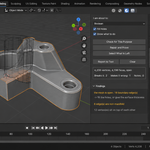
- Select the mesh. Several is fine; the active one is the one that gets repaired.
- Choose what you are about to do.
- Press Check for This Purpose.
- Press Repair and Prove.
3. The four purposes
Boolean — looks for non-manifold edges, open boundaries, coincident vertices, faces with no area, and faces that disagree on which way is out. Proves by cutting a copy and measuring the result.
Bake — looks for a missing UV map, overlapping islands, UV corners outside the square, and faces with no area. Proves by rasterising the layout and counting texels covered twice.
Export — looks for loose geometry, n-gons, unapplied and negative scale, and degenerate faces. Proves by measuring the mesh as an exporter sees it, after modifiers.
Subdivide — looks for edges with no length, coincident vertices, non-manifold edges, n-gons and disagreeing normals. Proves by subdividing a copy and counting sharp normal breaks.
4. The two weights
This is what breaks it — the operation will fail or produce nonsense.
This makes the result wrong — the operation will run, and the result will not be what you wanted.
5. Repair steps
Which steps run depends on the purpose. Every step reports what it changed as a number. Filling holes changes the shape of your model, so it only runs when you tick it. Triangulating n-gons is likewise optional and belongs to the export purpose.
6. The proof
The proof always runs on a temporary copy, before the repair and again after it, so the two numbers are comparable. The copy and its data are removed afterwards. If the proof does not pass, the panel says so and shows the numbers rather than claiming success.
7. What it never does
It does not retopologise, does not simplify, does not unwrap, and does not touch objects you did not select.
8. Report to Text
Writes the findings, the repair steps and the proof into a text block inside your file.
9. Compatibility
Blender 4.2 and later. Tested live on 5.1 and 5.2.
Render
Choose Render when the mesh looks right in the viewport and wrong in the final image. It counts faces standing in the same place as another face, faces built on the same vertices, faces pointing the wrong way, faces with no area, and n-gons that are not flat — the five things that produce flicker, dark patches and black specks. The first four are repaired; the last is reported and left alone, because cutting an n-gon into triangles changes the model and that is your call.
The proof counts the same things again on the mesh the renderer receives, after your modifiers. There is no test render: flicker depends on the camera angle, so a clean frame would prove nothing about the next one.
10. License
GPL-3.0.
Have questions about this product?
Login to message
| Published | about 2 months ago |
| Blender Version | 4.2 - 5.2 |
| Extension Type | N/A |
| Render Engine Used | Cycles, Eevee |
| License | GPL |