 Skava
Your whole Blender scene in Unity in one export, every part measured
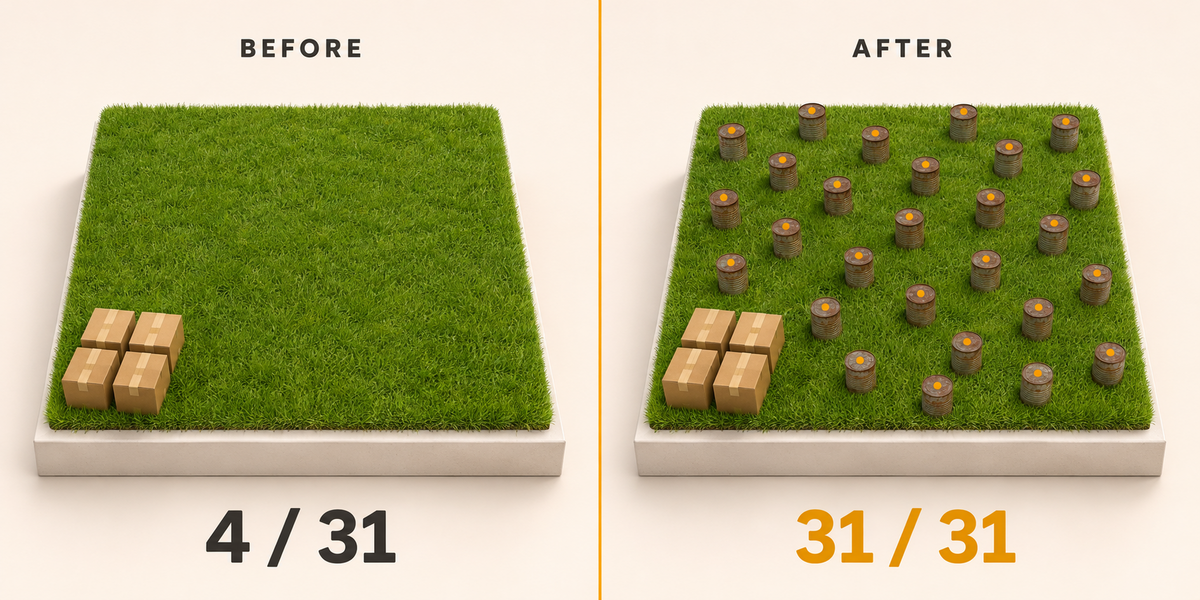
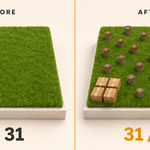
Blender's FBX export gives Unity your models, not your scene. On our test plaza it brought 4 of the 31 scattered copies (Blender's FBX exporter drops the 27 Geometry Nodes instances) and no Timeline. The characters and moving objects on a Timeline, the cameras with their lens and cuts, the lights, the terrain, the curves and the materials of everything that stands still are then set up by hand, one after another, and nothing tells you whether they still agree: whether the lights stand where the models are, whether the camera plays with the characters, whether one object came in twice.
SceneForge brings all of it over in one export. Each object goes to exactly one part (Stage, Cameras, Lights, Copies, Terrain, Splines or the set), so nothing arrives twice; everything lands in one Unity scene, and Check measures every part against Blender and says OK or FAIL. Your Blender file is left exactly as it was.
What you get
SceneForge does what six of our single tools do (StageForge, CamForge, LuxForge, PrefabForge, TerrainForge and SplineForge), plus a seventh part for the set and its materials, as one export and one Check. You do not need to own any of them.
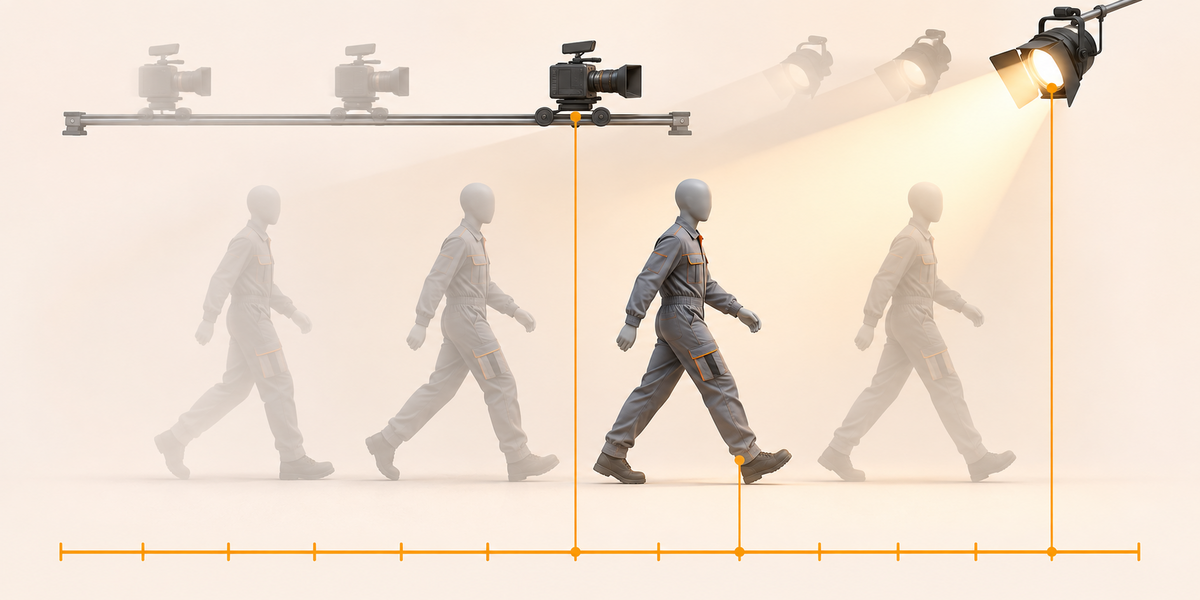
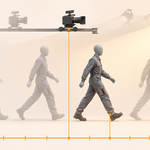
- Stage: characters, moving objects and what rides on them, sound strips and markers (as signals), on one Unity Timeline with a Playable Director.
- Cameras: placement and lens on every frame and between frames, and the cuts, played from the same Timeline.
- Lights: every light object the render sees as a URP light, as bright as Cycles lights your surfaces; animated lights play from the same Timeline. The World's light and the light that glowing materials throw are named by Scan, not carried; Unity's sky light, reflections and SSAO stay as your project has them.
- Copies: Geometry Nodes instances, particles and collection instances as one prefab per source and one prefab instance per copy.
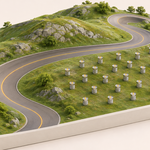
- Terrain: the mesh you name, as a Unity Terrain with its holes and material layers.
- Splines: your curves as Unity Splines with Blender's roll.
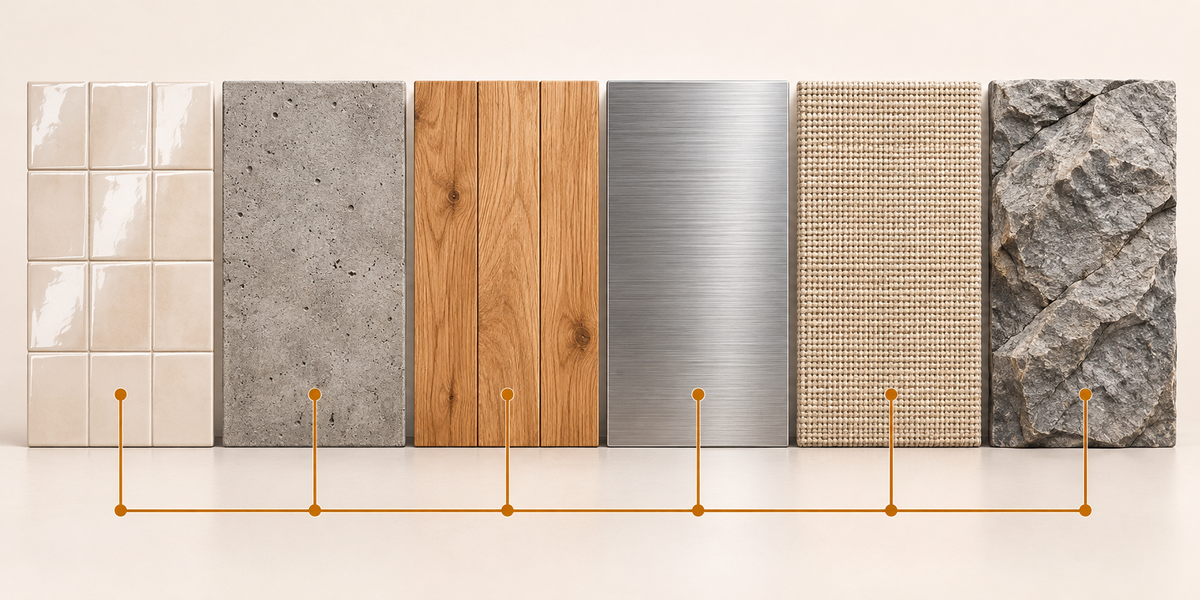
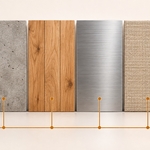
- The set: everything else that stands still, with one URP Lit material per Blender material: the Base Color image, roughness and metal written into one image the way URP reads them, the normal map with its strength, the tiling of a Mapping node.
- One scene in Unity with every part in it. Export and Set Up again after a change: every part updates what it made in place.
Measured, not promised
- Scan in Blender says which part carries each object and what cannot be carried, before anything is written; your file is left exactly as it was.
- Check in Unity runs every part's own check and then what only the whole scene shows: every part lands in the same Unity space, no object is drawn by two parts, the scene has no cameras or lights other than the ones SceneForge made, and the cameras and lights played by the Timeline match, in position and brightness, the way they play from their own animation.
- On our test plaza (Unreal's Manny walking, a moving cart, 18 still objects with six 4K ambientCG materials and five Poly Haven props, 31 copies, an 80 m terrain, two curves, two cameras with a cut, three lights), exported from Blender 4.2 and 5.2 into Unity 6 with URP: the set within 0.002 mm; at 121 proof points across its 12 materials the colour in Unity's material differs from Blender's by 0.0/255, and roughness and metal by at most 0.5/255; bones within 0.002 mm; cameras within 0.03 px; copies within 0.001 mm; the terrain 5.5 mm from Blender's surface against a 10 mm budget; splines within 0.004 mm and 0.003 degrees of roll; all parts in the same place to 0.000 mm; the Timeline plays the cameras and lights 0.000 mm and 0.000% off their own animation.
- Copies: SceneForge brings all 31 of the plaza's copies, each within 0.001 mm; the same plaza exported with Blender's FBX defaults brings 4.
- The lights: the sun and the bulb within 0.19% of Cycles; the key spot (50 degrees, Blend 0.2, Radius 0) within 0.59% at the very rim of its cone. A spot with a Radius above 0 has a softer rim in Cycles than URP draws, and Check says by how much. Six such spots on one floor stay within 0.31% each, and Check still says NOT OK on that scene: the Mobile quality level of Unity's URP template lights at most 4 spots per object, and Check says how to raise the limit.
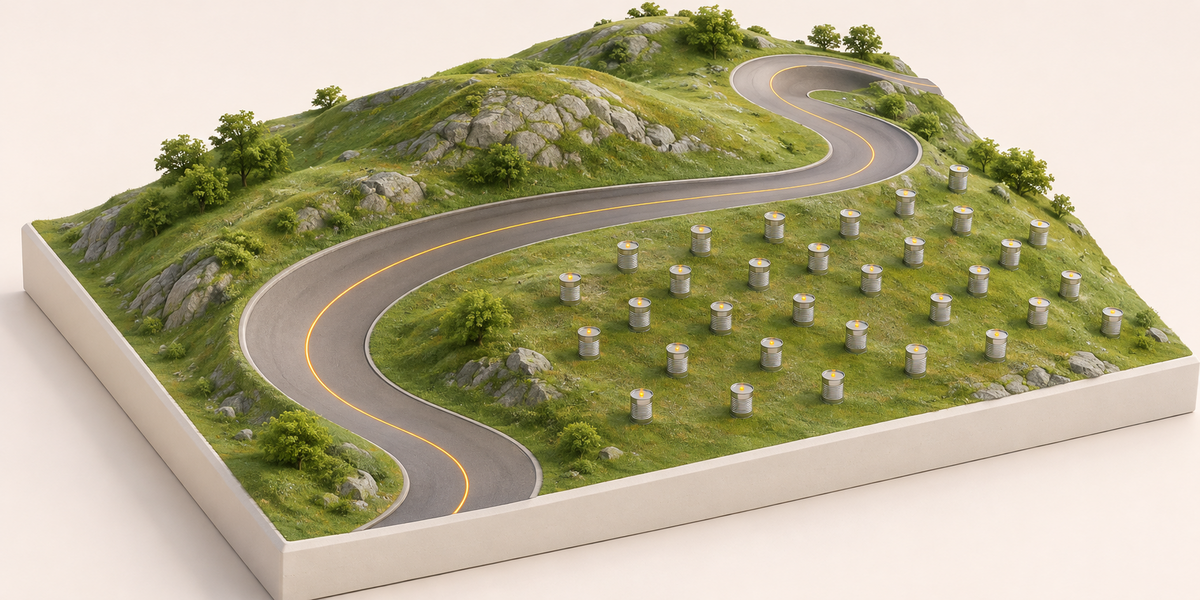
- A second scene, a glTF fox walking past particles that scatter 25 tins, two lamp posts copied as collection instances with two lights each, a NURBS path and a camera that zooms and follows, passes Check in every part from both Blender builds: the set within 0.001 mm, materials 0.9/255 and 0.5/255, cameras 0.01 px, five lights within 0.03%, 29 copies within 0.001 mm, the terrain 6.0 mm against 10 mm, the path within 0.58 mm.
- Check is tested by breaking things on purpose: an object moved 1 cm, a texture's tiling or offset, a texture swapped, a tint, the smoothness, a data image imported as sRGB colour, a normal map not imported as a normal map, a wrong material, the stage moved, the cameras unhooked from the Timeline, the lights half a second late, a camera's lens, a stray lamp, a copy moved 1 mm, the terrain raised, a spline moved, an object drawn by two parts. On the plaza each of these 20 fails Check, and Check is OK again once it is undone; on the fox scene the 18 that apply do the same.
Limits
- Each part keeps its own limits: meshes that deform without bones are exported as they look on one frame; panoramic cameras are not carried; an area light becomes a wide spot shaped like the panel's glow and differs close to the panel (Check measures how much), and an area Spread below 180 degrees is not carried; light nodes and light linking are not carried; per-copy attributes are not carried; a terrain holds one height per point.
- The set's materials are what URP Lit can draw: displacement, Bump nodes and mixes between images are named by Scan, not carried. Check compares the images as files; what Unity's texture compression does to them is not measured.
- Unity 6's URP template has two quality levels with different light cookie settings: the Lights check fails until both match, and says so.
- Between frames, Unity interpolates linearly from key to key; Check measures both on whole frames and at moments in between.
The Unity scripts are MIT licensed: ship them in your games, closed source or not.
Made for Unity 6 with URP: materials are URP Lit and lights are URP lights, so HDRP and the Built-in pipeline are not set up, and Unity versions before 6 were not tested. Needs Unity's own Timeline and Splines packages. Tested on macOS and Windows. Blender 4.2 to 5.2. No Python packages, no cloud, no account, no AI model.