 Skava
Skava
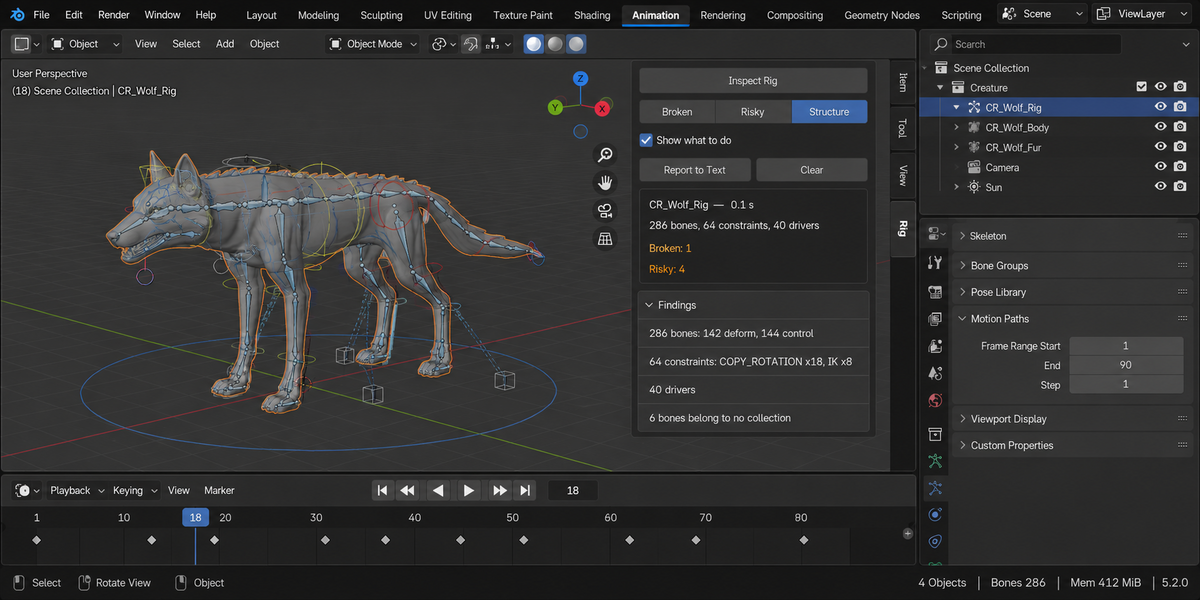

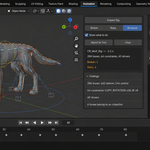
Rig Inspector — read any rig in a minute
A character arrives from a contractor, from a marketplace, from a project nobody documented. Which bones are controls and which deform? Where does that driver come from? Why will this bone not move? What will break on export? Finding out means opening bone after bone, constraint after constraint, for an hour.
Rig Inspector reads the armature and everything attached to it and answers those questions as a list you can click through — and it changes nothing at all.
It only reads
This is the whole design. No bone, no constraint, no weight, no mode is touched. In testing that is proved by taking a fingerprint of the entire rig before and after an inspection and comparing it byte for byte. The two things it ever writes are the report text block you ask for, and the bone selection when you click a finding to jump to it. A tool that never writes to your rig cannot corrupt it.
What it finds
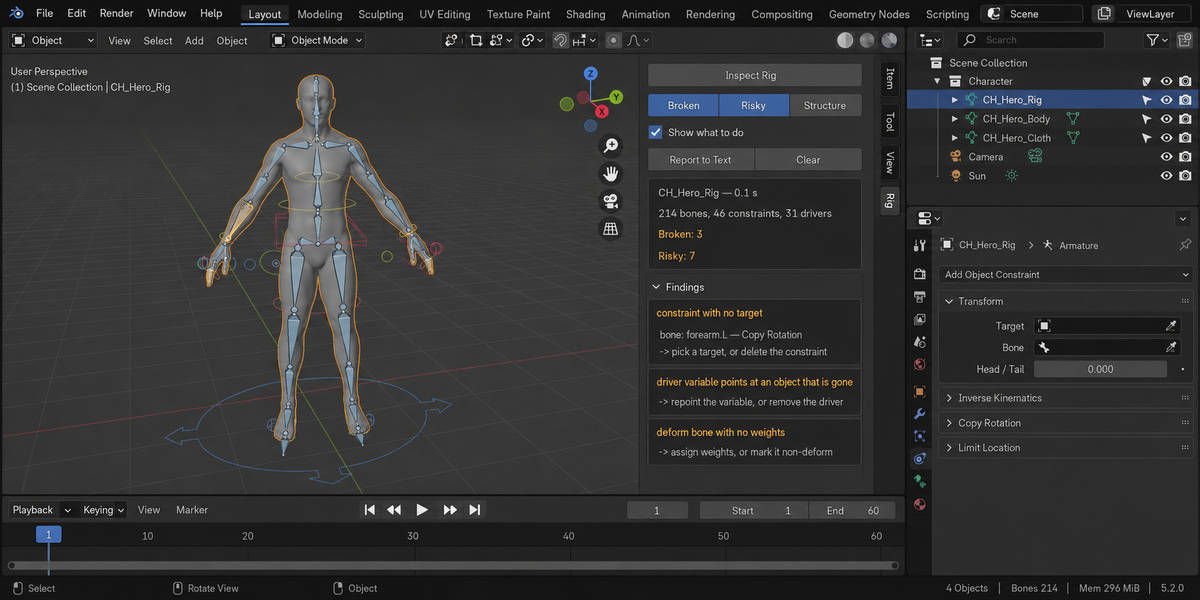
Broken — constraints with no target; constraints pointing at a bone that was renamed away; a constraint with a target armature but no bone chosen; constraints running in a circle; drivers Blender considers invalid; driver variables whose source object is gone; drivers reading a bone that no longer exists; drivers depending on themselves; custom shapes that are not in the scene, so the bone draws as nothing.
Risky — deform bones with no weights at all; vertex groups where every weight is zero, so the group looks skinned and deforms nothing; weights sitting on a bone with Deform switched off; bones whose every collection is hidden; hidden bones; bones locked on every channel with no constraint driving them, which is the usual answer to "why can I not move this"; bones with no length; an armature whose scale was never applied; constraints and drivers reaching for an object outside the rig.
Structure — how many bones and how many of them deform, constraints by type, drivers, bone collections, bound meshes. The part you read first when the rig is not yours.
Checked both ways
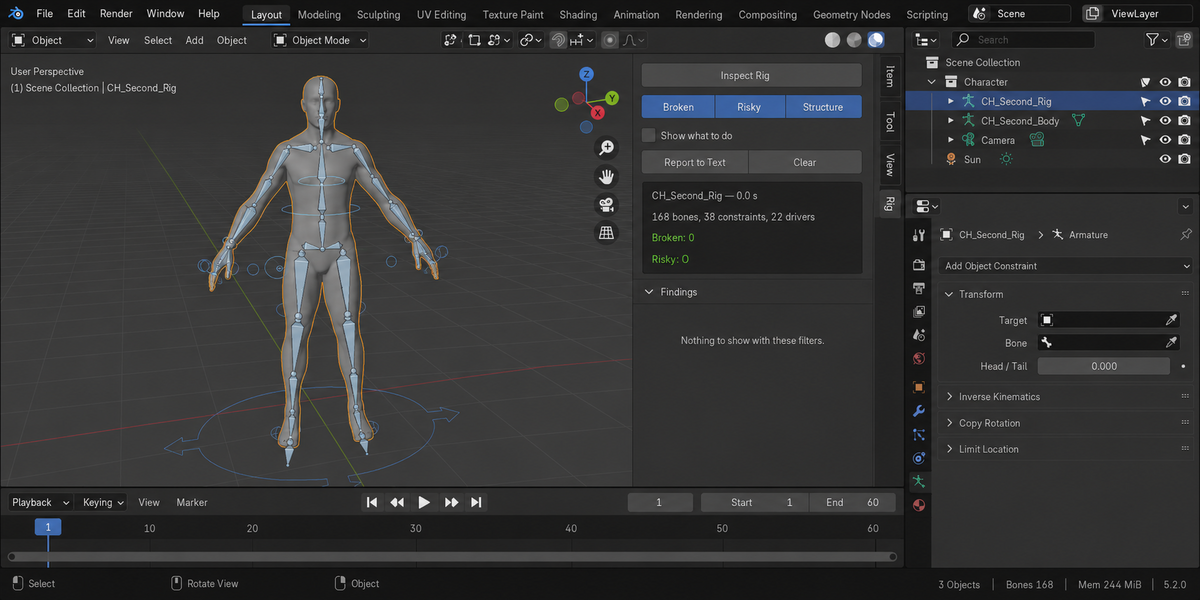
A diagnostic is only worth something if it is tested twice, and most are not. On a rig with fourteen deliberately planted faults, of fourteen different kinds, it finds all fourteen and nothing else. On a healthy rig it reports zero broken and zero risky. Both halves are part of the test suite, and both run on Blender 5.1 and 5.2 with every check green.
Every finding says what to do
Not an error code — one line of plain advice under each one, and a button that takes you straight to the bone in pose mode. Report to Text writes the whole thing, hints included, into a text block inside your .blend, ready to send to whoever handed you the rig.
Fast enough not to think about
A rig with 300 bones, 100 constraints and 100 drivers, skinned to a mesh of 24 578 vertices across 300 vertex groups, is read in 0.03 seconds. Production rigs are smaller than that.
What it does not do
It does not fix, rename, delete or retarget anything, and it writes nothing to disk. Whether a Mirror should be applied or a constraint deleted is a decision about your rig, and it stays yours.
Whole deliveries, not one file at a time
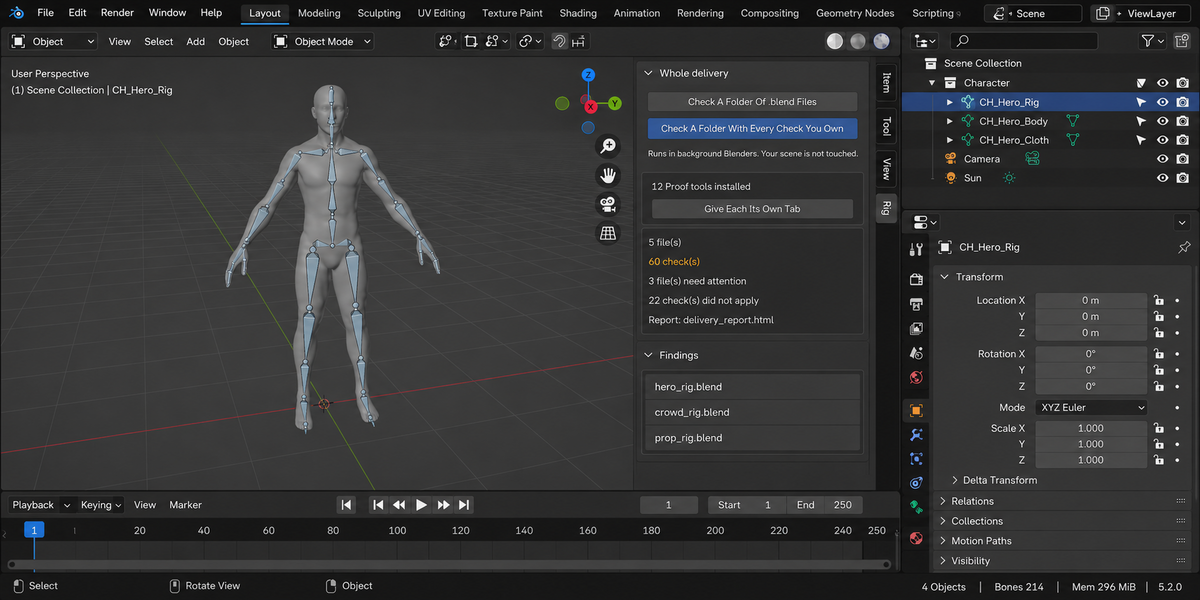
- Check a folder. Point it at a delivery and every .blend inside is checked, each in its own background Blender. The scene you have open is not touched — not opened over, not saved, not changed. A file that hangs or crashes takes only its own process down; the other thirty-nine still get checked.
- A report you can send. One self-contained page: verdict first, one sentence a lead can read, then the numbers, then every finding with its address. No internet, no fonts to load, no dependencies — it opens in six months on a machine with no network, which is exactly when someone asks what you delivered.
- Runs without a person. A single command from your pipeline writes the report and returns a code: clean, something blocking, or could not be checked. Those are three different codes on purpose — a check that did not run has not passed, and a gate that treats them the same is worse than no gate at all.
- Remembers last time. Save today's numbers as a baseline and a later run tells you what moved, in which direction, and which findings are new. A measurement that went up is not automatically bad: each product says which way is worse for its own numbers.
- One verdict for the whole delivery. If you own more than one of these tools, one run puts every check you have over every file and answers the only question that matters before you send it: can this go out? Each file is opened once and all the checks see the same state of it.
Compatibility
Blender 4.2 and later on Windows, macOS and Linux. Measured live on 5.1 and 5.2. Works on any armature — Rigify, Auto-Rig Pro, Mixamo, Character Creator or a rig with no naming scheme at all — because it reads what Blender itself sees.
License
GPL-3.0.